Showing posts with label mathematician. Show all posts

Sunday, September 20, 2026

Adolf Ferdinand Wenceslaus Brix: Mathematics, Engineering, and the Brix Scale

Adolf Ferdinand Wenceslaus Brix (1798–1870) was a German mathematician, engineer, educator, and public servant whose career reflected the growing importance of applied science during the 19th century. Born in Wesel, in the Prussian Rhineland, Brix combined theoretical mathematics with practical engineering and measurement. His work contributed to the development of technical education and scientific standards in Prussia, while his name eventually became permanently associated with one of the world's most widely used measurements in the food and beverage industries.

Brix pursued an academic career in Berlin, where he taught applied mathematics at the Gewerbeinstitut and higher analysis at the Bauakademie. These institutions played important roles in the development of technical education in Prussia and eventually became part of the institutional tradition leading to today's Technische Universität Berlin. Through teaching and technical writing, Brix helped prepare engineers for practical problems involving mechanics, construction, and quantitative measurement.

His professional activities extended well beyond the classroom. Brix held senior responsibilities in Prussian public administration and eventually became associated with the Royal Prussian Commission for Measurements. During this period, accurate and consistent measurement was increasingly important to engineering, commerce, manufacturing, and government. Standardized measurements allowed technical results to be compared reliably and supported the expanding infrastructure of industrializing Europe. Brix also contributed to public works and infrastructure projects in Berlin and Potsdam.

Brix's publications demonstrate the breadth of his scientific interests. He investigated subjects including mechanics, the elasticity and strength of iron wires, the mechanical resistance experienced by wagons, and alcoholometry—the measurement of alcohol concentration in liquids. These studies illustrate a characteristic feature of 19th-century applied science: mathematical principles were increasingly used to solve practical problems involving transportation, construction, materials, and industrial production.

Brix's most enduring legacy, however, is the degree Brix (°Bx). The Brix scale is commonly used to express the concentration of dissolved substances in a liquid, especially sugars. One degree Brix corresponds approximately to one gram of sucrose per 100 grams of solution when the measurement is based on a sucrose-water reference system. The measurement is traditionally determined using a hydrometer or refractometer, although modern instruments may use additional analytical methods.

Today, °Bx is particularly important in agriculture and food production. Fruit growers and processors use it to assess the sweetness and maturity of crops such as grapes, citrus fruits, and melons. Winemakers monitor Brix in grape juice to estimate potential alcohol levels after fermentation, while food manufacturers use it for quality control in products such as juices, syrups, and concentrates. In brewing and other industries, related measurements help monitor dissolved solids during production.

Although modern metrology is far more sophisticated than it was during Brix's lifetime, his emphasis on accurate measurement remains relevant. His career linked mathematics, engineering, education, public administration, and scientific standardization. More than a century after his death, the simple notation °Bx continues to carry his name, providing a lasting example of how applied science can transform an individual's work into a practical tool used around the world.
Adolf Ferdinand Wenceslaus Brix: Mathematics, Engineering, and the Brix Scale

Monday, May 11, 2026

D. R. Kaprekar: The Recreational Mathematician

Dattatreya Ramchandra Kaprekar (1905–1986) was an influential Indian recreational mathematician who made remarkable contributions to number theory despite working outside the world of professional academic research. He became widely known for identifying several fascinating classes of natural numbers, including Kaprekar numbers, Harshad numbers, and self numbers, as well as discovering the famous Kaprekar’s constant. His work demonstrated that mathematical creativity and insight can emerge from passion and curiosity rather than from prestigious research institutions alone. Today, many of his discoveries continue to inspire mathematicians, teachers, and students around the world because of their simplicity, elegance, and surprising numerical patterns.

Kaprekar received his secondary education in Thane and later studied at Fergusson College in Pune. His exceptional mathematical talent became evident during his college years. In 1927, he won the prestigious Wrangler R. P. Paranjpye Mathematical Prize for presenting an original mathematical work, an achievement that highlighted his innovative thinking and analytical ability. He later attended the University of Mumbai, where he completed his bachelor’s degree in 1929.

Although Kaprekar possessed extraordinary mathematical talent, he spent most of his professional life as a schoolteacher at a government junior school in Devlali from 1930 until 1962. Unlike many famous mathematicians who worked in universities or research institutions, Kaprekar conducted his investigations independently during his free time. His dedication to mathematics despite limited academic support makes his achievements even more impressive. Over time, his discoveries gained international recognition and became important examples in recreational mathematics and number theory.

One of Kaprekar’s most celebrated discoveries is Kaprekar’s Constant, 6174, identified in 1949. This constant is reached through a fascinating process involving four-digit numbers with at least two distinct digits. By arranging the digits in descending and ascending order and subtracting the smaller number from the larger one repeatedly, the result eventually reaches 6174 in no more than seven steps. This numerical phenomenon continues to amaze students and researchers because it reveals hidden patterns within ordinary numbers and demonstrates the unexpected beauty of mathematics.

Kaprekar also introduced Kaprekar numbers, positive integers whose squares can be split into parts that add back to the original number. For example, 452=202545^2 = 2025, and 20+25=4520 + 25 = 45. In addition, he studied Harshad numbers, meaning “joy-giver” in Sanskrit, which are divisible by the sum of their digits. 

He also described self numbers, or Devlali numbers, which cannot be generated by adding any number to the sum of its digits. Another contribution was his study of Demlo numbers, formed from the squares of repunits such as 1, 11, and 111, creating beautiful palindromic patterns like 121 and 12321. Through these discoveries, Kaprekar showed that mathematics can be both playful and deeply meaningful.
D. R. Kaprekar: The Recreational Mathematician

Monday, February 12, 2024

Johann Radon's Mathematical Contributions

Johann Karl August Radon, born on December 16, 1887, and passing away on May 25, 1956, is widely revered as a luminary in the domain of mathematics, his profound contributions resonating across various branches of the discipline. Hailing from Tetschen, Johann's formative years were shaped by a nurturing blend of familial affection and scholarly zeal, nurtured by his father Anton, a prominent figure in the local banking sphere, who imparted upon him values of discipline and determination, pivotal in shaping his academic trajectory.

Despite modest beginnings, Johann's intellectual acumen shone brightly from an early age. Surpassing expectations, he completed the demanding five-year elementary curriculum in an impressive four years, showcasing a natural inclination towards academic excellence. This early brilliance persisted through his higher education journey, culminating in the attainment of a doctoral degree from the esteemed University of Vienna in 1910, his thesis delving into the intricacies of calculus of variations, hinting at the profound contributions he would later make to mathematical theory.

Post-doctorate, Radon's career trajectory soared to new heights. His appointment as an extraordinary professor at the University of Hamburg in 1919 underscored his burgeoning reputation within academic circles. Despite finding contentment in Hamburg initially, Radon's insatiable intellectual curiosity and thirst for fresh challenges led him to embrace a full professorship in Greifswald by 1922, exemplifying his unwavering pursuit of mathematical enlightenment through exploration of novel avenues.

Radon's seminal work in applying calculus of variations to differential geometry marked a watershed moment in mathematical inquiry. His groundbreaking discoveries, notably the Radon curves, served as a bridge between theoretical frameworks and practical applications, laying the groundwork for transformative mathematical constructs such as the Radon-transformation, Radon-numbers, and theorems that would etch his name into mathematical lore.

A cornerstone of Radon's enduring legacy lies in his revolutionary elucidation of the Radon transform. By demonstrating the extraordinary proposition that a three-dimensional object's image could be reconstructed from an infinite array of two-dimensional projections, Radon catalyzed a seismic shift in the field of imaging, with far-reaching implications across domains such as medical imaging and computerized tomography.

In essence, Johann Radon's indelible mark on the canvas of mathematics stands as a testament to his unwavering commitment to intellectual rigor and innovation. His life's work continues to serve as a beacon of inspiration, resonating with mathematicians and scholars alike, underscoring the transformative power of human intellect in unraveling the mysteries of the universe.
Johann Radon's Mathematical Contributions

Wednesday, December 29, 2021

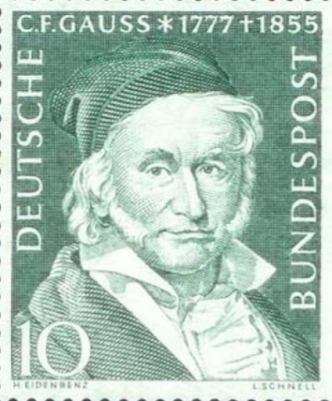
Carl Friedrich Gauss (1777-1855) – Mathematician and physicist

During his lifetime, the Braunschweig (Brunswick) native Carl Friedrich Gauss was called princeps mathematicorum, the prince of mathematics. Gauss is generally regarded as one of the greatest mathematicians of all time for his contributions to number theory, geometry, probability theory, geodesy, planetary astronomy, the theory of functions, and potential theory.

Gauss was born on April 30, 1777, in Brunswick (Braunschweig), which was then a residential town. He was the son of Gebhard Dietrich Gauss, a bricklayer, and Dorothea Emerenzia Gauss.

At the age of 14, Gauss came to the attention of the Duke of Brunswick: the Duchess saw Gauss reading in the palace yard one day, and was much impressed that Gauss understood what he was reading. When Gauss entered the Collegium Carolinum in 1792, the Duke of Brunswick, Carl Wilhelm Ferdinand (1735-1806), paid his tuition.

Gauss learnt mathematics primarily on his own. He was an autodidact. His library allows to follow the traces of his learning. He began with easy books, like the reckoning masters. For example, Gauss’ library contains books of Johann Hemeling and Valentin Heins. Mathematical textbooks came after.

At the Collegium, Gauss studied the works of Newton, Euler, and Lagrange. His investigations on the distribution of primes in 1792 or 1793 give an early indication of his interest in number theory. He also developed his strong love of languages: he “completed his knowledge of the ancient languages and learned the modern languages”.

Gauss attended the University of Göttingen and in 1799 obtained a Doctorate in Mathematics from the University of Helmstedt. About this time, he turned his attention to astronomy, making brilliant computations of orbits of asteroids.

His dissertation, written in Latin, of 1799 is dedicated with enormous gratitude to his sovereign “Serenissimo Principi Ac Domino Carolo Guilielmo Ferdinando”. His dissertation adviser was the most respected German mathematician of the time, Johann Friedrich Praff (1765-1825).

In 1801 he published at last his Disquisitiones arithmeticae, his arithmetical masterpiece concerning number theory. His sources had mostly been French mathematicians and Euler. The book is divided into seven chapters, called sections. The first three are introductory, sections IV–VI form the central part of the work and section VII is a short monograph devoted to a separate but related subject.

Gauss’ astronomical main work Theoria motus corporum coelestium in sectionibus conicis solem ambientium (Theory of the motion of the heavenly bodies moving about the sun in conic sections) appeared in Hamburg in the early summer of 1809.

In 1807, Gauss became director of the observatory in Göttingen, a post he held until his death in 1855.
Carl Friedrich Gauss (1777-1855) – Mathematician and physicist

Wednesday, October 6, 2021

Isaac Newton: English physicist and mathematician

Born: December 25, 1642
Died‎: ‎ March 20, 1727
Isaac Newton was born prematurely in the manor house of the tiny village of Woolsthorpe, near Grantham in Lincolnshire, England, of Hannah Ayscough and Isaac. His father, who had died 3 months before Newton was born, was a yeoman farmer, who if not wealthy had sufficient means, and left a sizeable will. When Newton was 3 years old, his mother remarried the rector Barnabas Smith, from the next village 2 km away, leaving Newton to be raised by his grandparents.

He attended the King’s School in Grantham where he learned Latin among other things until the age of 17. In 1661, he was admitted to Trinity College, Cambridge. He went to Cambridge University, intent on obtaining a law degree. Instruction at Cambridge was dominated by the philosophy of Aristotle but Newton also studied the philosophy of Descartes, Gassendi, Hobbes, and in particular Boyle. While at Cambridge he also became interested in mathematics, optics, physics and astronomy.

Sometime in late 1663 Newton also discovered mathematics- a subject not taught in any way at school, and barely at university. By 1664 he was buying various advanced books, which by Christmas 1664 included the works of Franz van Schootens, Descartes, and Wallis, on geometry, algebra, and infinite series. During this time period Newton seems to have absorbed much of the mathematics of his day, purely by solitary study, and become extremely interested in both pure mathematics and how it might be applied to the world.

Isaac Newton was an English physicist and mathematician, who made seminal contributions to several domains of science, and was considered a leading scientist of his era and one of the most influential scientists of all time. 

Newton’s greatest achievement was his work in physics and celestial mechanics, which culminated in the theory of universal gravitation. By 1666, Newton had early versions of his three laws of motion. Using his discoveries in optics, Newton constructed the first reflecting telescope.  

His invention of the reflecting telescope brought fellowship in the Royal Society in 1671. A year later he published a letter in the Transactions of the Royal Society on his “new theory of light and colours.”

In 1667 he returned to Cambridge and became a fellow of the College of the Holy and Undivided Trinity. In 1669, and at the age of 26, Newton became the Lucasian professor of mathematics. 
In 1704 Newton published his Opticks (in English), & the Latin translation in 1706. It was wildly popular.

In addition to his work on optics, Newton made seminal contributions to several other scientific disciplines. In his book the Principia or “Mathematical Principles of Natural Philosophy,” which was published in 1687, Newton formulated the laws of motion and universal gravitation and is considered to have laid the foundations for classical mechanics. 

He also introduced the notion of a Newtonian fluid, studied the speed of sound, and developed an empirical law of cooling among other major contributions made to scientific discovery. 

In 1705 he was knighted, the first scientist to be so honoured for his work.
Isaac Newton: English physicist and mathematician

Monday, August 10, 2020

James Clerk Maxwell: Scottish scientist

James Clerk Maxwell (13 June 1831 – 5 November 1879) was a physicists’ physicist, the prime author of the modern theory of colour vision, the principal creator of statistical thermodynamics, and above all the author of the classical electromagnetic theory, with its identification of light and electromagnetic waves.

James Clerk Maxwell was born at 14 India Street, Edinburgh, but he spent his early childhood (1831-41) at Glenlair in Scotland. His mother tragically died from cancer when he was eight-and-a-half years old. His father John Clerk Maxwell was an inspirational man—a lawyer with a strong scientific and technical interest: idiosyncratic, enquiring, versatile, energetic, compassionate, an independent character who educated young James by example more diversely than any formal school could have achieved.

His father did not neglect James’s formal education. He attended the school at Edinburgh Academy during 1841-47. While in school, at the age of 14, he published his first scientific paper ‘On the description of oval curves and those having a plurality of foci’. This fascination for geometry and for mechanical models continued through his whole career, and was of great help in his subsequent research.

From 1847 to 1850 he attended Edinburgh University when he was sixteen, and during this time he worked on the application of optical techniques to the study of elastic solids; from 1850 to 1854 to the University of Cambridge as an undergraduate, initially to Peterhouse but before the first year was out to Trinity.

In 1854 he came overall second in the final examinations, beaten only by E.J. Routh (of Routh's Rule for calculating moments of inertia). He was immediately given a staff position at Cambridge. Released from the pressures of formal examinations. Maxwell threw himself into original work.

In early 1856, James Clerk Maxwell, a young Fellow of Trinity, applied for the post of professor of natural philosophy at Marischal College, Aberdeen.

He soon found a post at King's College, London, where he came into contact with Faraday. At London, he published many of his most famous papers, including his Dynamical Theory of the Electromagnetic Field in 1864 which included the famous equations.

In 1865 Maxwell published A Dynamical Theory of the Electromagnetic Field. It was with this that he first proposed that light was in fact undulations in the same medium that is the cause of electric and magnetic phenomena. His work in producing a unified model of electromagnetism is one of the greatest advances in physics.
James Clerk Maxwell: Scottish scientist

Monday, July 6, 2020

Christiaan Huygens: the founder of modern mathematical physics

Christiaan Huygens Dutch mathematician, astronomer, and physicist, who founded the wave theory of light, discovered the true shape of the rings of Saturn, and made original contributions to the science of dynamics—the study of the action of forces on bodies.

Christiaan Huygens was born on 14 April 1629 in den Haag (the Hague), the second child of the poet and statesman Constantijn Huygens and his wife, Suzanna van Baerle.  Christiaan’s father was one of the best-known poets and authors of the Netherlands, and Christiaan was taught at home by his father and private tutors.

From May 1645 until March 1647 Christiaan studies law and mathematics at the University of Leiden, the oldest university in the Netherlands. He studied classical mathematics as well as the modern methods of Viéte, Descartes, and Fermat.

Christiaan took courses from Franz van Schootens, the best-known mathematician  in the Netherlands at that time, and a friend of (and prominent exponent of the ideas of) Descartes.

In 1651, Huygens was to discover a well-concealed flaw in the vast work of Gregorius van Saint-Vincent on the quadrature of the circle [the surface area under the segment of a circle], meriting this praise from Van Schooten for his work.

Huygens at first concentrated on mathematics: determinations of quadratures and cubatures, and algebraic problems inspired by Pappus’ works. In 1651 the Theoremata de quadratura hyperboles, ellipsis et circuli appeared, Huygens was to discover a well-concealed flaw in the vast work of Gregorius van Saint-Vincent on the quadrature of the circle [the surface area under the segment of a circle], meriting this praise from Van Schooten for his work.

In 1656 Huygens invented the pendulum clock. In 1664 Thévenot approached Huygens to offer him membership in an academy to be founded in Paris; Colbert proposed giving official status and financial aid to those informal meetings of scholars which had been held in Paris since Mersenne’s time. In 1666 Huygens became one of the founding members of the French Academy of Sciences, which granted him a pension larger than that of any other member and an apartment in its building.

Huygens wrote his greatest works - the Horologium Oscillatorium and the Treatise on Light – retired from the public eye in his home in Holland due to ill health.

In 1694 Huygens fell ill. He did not recover. He died the following summer in The Hague on 8 July 1695.
Christiaan Huygens: the founder of modern mathematical physics

Thursday, March 29, 2018

French mathematician Jean-Baptiste Joseph Fourier (1768–1830)

Joseph Fourier is best known for his computational approach to complex function analysis, specifically the Fourier transform. He also acknowledged as an Egyptologist and administrator, who greatly influenced mathematical physics his book.

Joseph Fourier was born on March 21, 1768 in the ancient and beautiful town of Auxerre, 150 kilometers south of Paris in a position dominating the river Yonne, with beautiful churches, above all the ancient fifth century abbey St. Germain and the Gothic cathedral of St. Etienne. He was the ninth of 12 children from his father’s second marriage. Joseph was the name of his father, a master taylor of Auxerre, who had been born to shopkeepers in a small town in Lorraine.

In 1794 Joseph Fourier was accepted to study at the Ecole Normale in Paris. In 1795, Joseph Fourier went to teach at the Ecole Polytechnique, In 1797, he succeeded Joseph-Louis Lagrange as chair of analysis and mechanics. While an engineer on Napoleons’ Egyptian expedition, he conducted (1798-1801) anthropological investigations and wrote the preface to the monumental Description de I’Egpyte, whose publication he oversaw.

When Joseph Fourier published his book Teorie analytique de la chaleur (1822), he certainly could not foresee that he had provided scientists of the 20th century with one of their most powerful research tools. He analyzed the conduction of heat in solid bodies in terms of infinite mathematical series now called the Fourier series.
French mathematician Jean-Baptiste Joseph Fourier (1768–1830)

Thursday, March 1, 2018

Jamshid al-Kashi of Samarkand

Jamshid al-Kashi of Samarkand (c. 1380 – 22 June 1429) was an Arab mathematician and astronomer. Noteworthy for the accuracy of his computations, especially in connection with the solution of equations by Horner’s method and his practice of using decimal fractions, both of which he derived from the Chinese.

Al-Kashi paid special attention to the method of measuring the parts of edifices and building such as arches, vaults, hollow, cupolas and stalactite surfaces widely wonted in the medieval East.

Calculated correctly π to 16 decimal places, No mathematician approached this accuracy until the late 16th century.

Between the 14th and the 15th century, Al-Kashi wrote the Key to Arithmetic. In this work he calls binomial coefficients “exponent elements”. The book provides a glimpse of the influence of Chinese mathematics.

Al-Kashi found patron in the prince Ulugh Beg, grandson of the Mongol conqueror Tamerlane. At Samarkand, where he held his court, Ulugh Beg had built an observatory in 1428 and al-Kashi joined the group of scientist gathered there.
Jamshid al-Kashi of Samarkand

Sunday, October 22, 2017

Aleksandrov, Pavel Sergeevich


Aleksandrov, Pavel Sergeevich (1896-1982) was a Russian mathematician, who was a leading member of the Moscow school of topology. Born in Bodorodska, Aleksandrov graduated from Moscow University in 1917. He joined the faculty in 1921 an in 1929 was appointed to the chair of mathematics.

He planned, in collaboration with the Swiss mathematician H.Hopf, to produce a definitive multi-volume topological treatise. Only the first volume, Topologie 1 (1935), was published. It was nonetheless extremely influential and did much to encourage the development of the Moscow school of topology. Aleksandrov’s own work, initially in set-theoretic topology, later moved into the field of algebratic topology.

During his life, he wrote about three hundred papers, making important contributions to set theory and topology.
Aleksandrov, Pavel Sergeevich

Wednesday, December 21, 2016

Johann Bernoulli (1667–1748)

Johann Bernoulli was the younger brother of Jacob. He was born in August 6, 1667 in Basel, the 10th child of a wealthy mercantile family. Like his brother, he made a false start in his career, studying medicine and taking a doctorate at Basel in 1694

His first publication of fermentation processes appeared in 1690 and he earned his doctorate in 1694 with a medical dissertation in the field of medicine with a thesis on muscle contraction. His doctoral dissertation on the movement of muscles was interesting in that it was evidently the first attempt to apply the methods of higher mathematics to physiology.

He became fascinated by calculus, quickly mastered it and applied it to many problems in geometry differential equations and mechanics.

In 1695, he was pointed Professor of Mathematics and Physics at Groningen in Holland, and on Jacob’s death he succeeded his brother in professorship at Basel.

He died on January 1, 1748 in Basel. Johann Bernoulli was a leading proponent of Leibnizian differential calculus and his genius in solving particular mathematical problems made him one of the top mathematician of his time.

Main discoveries in mathematics by Johann Bernoulli are: the exponential calculus, trigonometry treated as a branch of analysis, the study of geodesics, the celebrated solution of the brachistochrone, and introduction of the treatment of minima and a foundation for the calculus of variations and more important from the viewpoint of this essay, the enunciation of the principle of virtual work.
Johann Bernoulli (1667–1748)

Wednesday, October 26, 2016

John Louis von Neumann (1903-1957)

The mathematician John von Neumann made important contributions of many areas of mathematics and quantum physics before turning to computers and developing the theoretical foundations of digital electronic computers.

Von Neumann was born to an aristocratic family on December 28, 1903 in Budapest, Austria-Hungary. He was the eldest of three sons born to Margaret von Neumann and Max von Neumann, successful banker.

At the age of 18, von Neumann had his first mathematical paper published with M.Fekete, his tutor. This paper showed how to solve a problem on the location zeroes of certain minimal polynomials.

 In 1921 von Neumann commenced study of mathematics at the University of Budapest and at the University of Berlin and in 1925 he received his degree in chemical engineering from the Swiss Federal Institute of Technology, in Zurich.

 In 1926 he earned his PhD in mathematics from the University of Budapest, where he wrote his dissertation on set theory. During the 1920s, while von Neumann was in Europe, he focused his works in two main areas: ‘set theory and logical foundations of mathematics’, and ‘Hilbert space theory, operator theory and the mathematical foundations of quantum mechanics’. On top of that he successfully gained a reputation of his work on set theory and quantum mechanics especially the theory of measurement.

The von Neumann minimax theorem was proved in 1928 and was major millstone in the theory of games, von Neumann continued to think about game and wrote the classic Theory of Games and Economic Behavior (written with economist Oskar Morgenstern) in 1944.

Von Neumann spent the rest of his career at Princeton University, first as a visiting professor, then as a professor of mathematics at Princeton’s Institute for Advanced Study from 1933 until his early death in 1957.

During World War II, the need for advanced computing technology increased within various military research programs. Von Neumann also participated n these research programs as a consultant and he got involved in aerodynamics, high explosives, atomic bombs, electronics, the development of high-speed calculating machine, etc.

von Neumann was a gregarious man with sophisticated tastes, a command of four languages, a prodigious memory, and an amazing ability to perform calculation in his head. He died February 8, 1957 in Washington, DC of brain cancer.
John Louis von Neumann (1903-1957)

Wednesday, August 17, 2016

Snellius Willebrord

Snellius Willebrord (13 June 1580 – 30 October 1626) was a famulus of Tycho Brahe in Prague 1600 and went on to become one of the leading mathematicians of the early seventeenth century.

Snellius Willebrord was born 1580 in Leiden, where his father Rudolphus Snellius, was professor of mathematics for thirty years.

Although he studied law at the University of Leiden, he was most interested in mathematics and at age nineteen he received permission to lecture on mathematics and astronomy. Later he succeeded his father as professor of at the university.

Snellius Willebrord
Between 1600 and 1602, he traveled through Europe, pursuing an interest in astronomy, especially at Paris toward the end of his tour.

Snellius is famous for having explained the refraction of light, discovering the sine law, and improving the method for calculating approximate values for π.

Based in research begun in 1615, he published in 1617 his Eratostheses Batavus, a work advancing his method for measuring the size of the earth through the use of triangulation, concept first proposed by the sixteenth-century scientist Tycho Brahe.
Snellius Willebrord

Thursday, November 12, 2015

Willem Jacob 's Gravesande

Willem Jacob 's Gravesande was born at Bois-le-Duc on 27 September 1688, the son of Dirk Storm van’s Gravesande, sheriff and councilor of the city of ‘s Hertogenbosch and steward of the lands of William II, King of England and later of Prince William IV.

On his mother’s side, ‘s Gravesande was descended from the Leiden professor Johannes Heurnius. Educated at home, ‘s Gravesande entered the University of Leiden in 1704, at the age of sixteen in order to study law.

He published at the age of 18 an essay on perspective, which was applauded by Bernoulli. He obtained his doctorate in Jurisprudence in 1707, with a dissertation on suicide and for a decade practiced Law in The Hague.

In 1717, ‘s Gravesande was appointed professor of astronomy and mathematics at Leiden. He taught the Newtonian system. His inaugural lecture was entitled On Mathematics in all the Sciences, especially in physics, and also about the Perfection of Astronomy to be Derived from Physics.

His philosophical writings are marked by the precision to which mathematical studies had habituated him; but being unable to decide between the doctrine of Locke, Descartes and Leibnitz, he borrowed ideas from each. He was the first to introduce the theories of Newton upon the continent.

He remained at Leiden until his death, adding the professorship of cavil and military architecture in 1730, and finally becoming professor of philosophy in 1734.

‘s Gravesande was a generalist who made few original contribution to science, yet he was perhaps the most famous scientist in Europe.
Willem Jacob 's Gravesande

Monday, August 3, 2015

Biography of Thales of Miletus

Diogenes Laertius says that Ionian philosophy began with Anaximander but that Thales instructed Anaximander.  Aristotle considered Thales to be ‘the first founder of this kind of philosophy, for example, the thought of those subject who sought to find what he called the ‘material cause ‘ of things.

Though he was the son of a Phoenician mother, Thales of Miletus was a citizen of the Ionian city of Miletus. Thales’s mother bore the Greek name Cleobulina; his father was called Examyes, a name used by Carians, the indigenous people of southwestern Anatolia.

Thales was born in Miletus, the premier city of Archaic Greece (in modern Turkey). Eventhough little is known about his life, Thales came to be known as the first of the ‘Seven Sages’ or wise men of the ancient world.

He was a founder of the Ionian school in the pre-Socratic Era. Thales was an astronomer, mathematician and philosopher. He was born in 624 BC and died in 565 BC.

Thales established a heritage of searching for knowledge for knowledge’s sake, development of the scientific method, establishment of practical methods and application of a conjectural approach to question of natural phenomena.

Miletus was a seaport on the trade routes that linked the Mediterranean world with India and other countries of the Near East, Ass Thales traveled outside his local community, he became known as Thales of Miletus.

As a young man, he traveled to Egypt and the Near East to study geometry, a branch of mathematics concerned with points, lines and surfaces in two dimensions. He learned how Egyptians used practical geometrical techniques to measure distances and to calculate areas of plots of farmland.

Thales learned astronomy from Chaldaeans at Babylon. He learned of the ‘Saronic cycle’ that is to say the interval of eighteen years and eleven days, a multiple of which the observation of ages by temple star-gazers had shown to be usual between eclipses of the sun. Knowledge of this enabled the shrewd travel to make a lucky forecast of the eclipse visible at Miletus in 585 BC.

It was Thales of Miletus, who was credited with the discovery of the electrostatic attraction. Thales noted that after amber was rubbed, straw was attracted to the piece of amber.

The Neo-Platonist philosopher Proclus, writing in the fifth century AD, says that Thales learned geometry from the Egyptian and brought the knowledge back to Greece. Thales is noted for his contributions in geometry and cosmology.

Thales was also supposed to be the first to prove various geometrical theorems and it was said that he used geometry to measure the heights of the pyramids in Egypt and the distance of ships at sea.

Aristotle claimed Thales as the first person to propose natural, rather than mythical, causes for the creation of the ‘kosmos’ or world. In developing a rational theory of the kosmos, Thales asserted that water was the first principal; that is water is the material cause of all things.
Biography of Thales of Miletus 

Wednesday, July 22, 2015

Euler, Leonhard (1707-83)

Leonhard Euler, one of the most prolific mathematicians in history is considered one of the founders of pure mathematics and analysis.

Euler was born on April 15, 1707, in Basel Switzerland. His father, Paul Euler, a Calvinist minister, and his mother, Margaret Brucker, married the year before his birth.  His interest and talent for mathematics showed itself early, and he received special instruction from Johann Bernoulli.

In 1720 Euler entered the University of Basel at the age of 14; there he discussed mathematics with Daniel Bernoulli.

In 1720 he joined the Department of Arts of the University of Basel, where he received the prima laurea in 1722 and in 1723 he earned a master’s degree in philosophy. He joined the Department of Theology, but devoted most of his time to mathematics.

In 1731 Euler moved to the department of physics as a professor. In 1733 Euler succeeded Daniel Bernoulli as first chair of mathematics at St. Petersburg. Frederick the Great invited Euler to become a member of the Berlin Academy in 1741 and he held joint appointments in Berlin and in St. Petersburg until he was appointed the director of the St. Petersburg Academy of Science in 1766.

His book Mechanica (1736-1737) provided the most mathematically sophisticated treatment of Newtonian and post-Newtonian mechanics to date, putting mechanics in analytic rather than geometric terms.

He also set forth, in New Theory of Light and Color (1746), a theory of light as vibration, as opposed to the dominant Newtonian the theory of light as a particle.

Euler wrote several papers on the physical constitution of celestial bodies (mainly on comets) as well as on celestial and terrestrial phenomena related to the Earth’s atmosphere or its magnetic field.

Euler’s devotion to his work lasted until the day he died, September 18, 18783, in St. Petersburg, Russia, where he spent time formulating laws of ascent for the recently invented hot-air balloon.
Euler, Leonhard (1707-83)

Monday, June 29, 2015

John Forbes Nash, Jr. (June 13, 1928 – May 23, 2015)

John Forbes Nash, Jr. was born almost exactly four years after his parents’ marriage, in Bluefield, West Virginia to John Forbes Nash, Sr., an electrical engineer with Appalachian Power Company and Margaret Virginia Martin and English and Latin teacher.

His mathematics skills were recognized at a young age, and his parents arranged for him to take extra classes at the local Bluefield College while still in high school.

In 1945 Nash won one of 10 George Westinghouse Scholarship in a national competition and entered Carnegie Institute of Technology in Pittsburgh, Pennsylvania, majoring in chemical engineering.

Harvard University and Princeton University offered him fellowships; he chose Princeton because it was closer to home and they seemed more eager to have him come to the school.

He entered Princeton in 1948, where he pursued broad interests in several branches of pure mathematics, including topology, algebraic, geometry, game theory and mathematical logic.

John Nash was renowned for his works in game theory, differential geometry and partial differential equations.

In 1994, he was awarded the Nobel Prize in Economics, which he shared with the mathematical economists and game theorist Reinhard Selten and John Harsanyi.

In 1978, Nash was awarded the John von Neumann Theory Prize for his invention of non cooperative equilibria, now called Nash equilibria and in 1999 Nash was awarded the Leroy P. Steele Prize by the American Mathematical Society.

John Nash passed away on 23 May 2015. He was 86 and died in a car crash along with his wife Alicia Nash in New Jersey.
John Forbes Nash, Jr. (June 13, 1928 – May 23, 2015)

Wednesday, September 3, 2014

Short biography of Blaise Pascal

Blaise Pascal was a gifted mathematician. He (19 June 1623 – 19 August 1662) was born in a middle class French family. His father was a lawyer.

His mother dead early in 1632 and he was left to be with his father and his sister. They family moved to Paris, where Pascal was educated by his father, showing precocious aptitude in science, mathematics and Latin.

When he was only 17, he wrote an essay on geometry that as world class. He founded the whole science of probabilities.

He followed his father back to provincial France in 1640, when the family settled in Rouen, and remained there for the next seven years.

Pascal did not remain idle, inspired by a desire to help his father with the time consuming mathematical calculations, Pascal invented the first mechanical calculation machine in 1642.

Pascal was the inventor of the barometer. He studied the region above the mercury, insisting that it was a vacuum.

After convincing his brother in-law to climb a mountain in France, he concluded that the height of the mercury in the thermometer dropped as the mountain was scaled, indicating that pressure decreases with altitude.

In 1647, Pascal published his Experiences nouvelles touchant le vide; this was the summary of a series of experiments he conducted with Pierre Petit, using variously sized and shaped tube and different liquids.

He made significant contributions to mathematics, especially in the fields of geometry, number theory and probability theory and he also helped to describe the ‘esprit geometrique’ which characterized the new science of the 1650s.

Pascal had suffered from life-long ill-health and died at the age of 39 in Paris.
Short biography of Blaise Pascal

Sunday, January 12, 2014

Brahmagupta

Brahmagupta is a renowned astronomer and mathematician of the seventh century. It was he who taught the Arabs astronomy before they became acquainted with Ptolemy.

Brahmagupta was born in Ujjain, India in 598 AD. Brahmagupta worked in the great astronomical center of Hindu science, Ujjain, a town in the state o Gwalior, Central India, said to have been the vice-regal seat of Asoka during his father reign at Patna.

His famous text Brahmasphutasiddhanta (The opening of the universe). Brahmasphutasiddhanta is Brahmagupta most important work. It is a standard treatise on ancient India astronomy. 

Brahmasphutasiddhanta composed in 628 Ad contains twenty five chapters including Dhyanagrahopadesadhyaya, is also observed by Al-Biruni – Muslim scholar and polymath of the 11th century.

The first 10 chapters pertain solely to astronomy, discussing the longitude of the planets, lunar and solar and solar eclipses and the timing alignments.

Chapter 7 is on mathematics. It deals with elementary arithmetic, algebra and geometry.

Brahmagupta goes on to describe the decimal place value system use in India. He permits zero as a valid number in all of his computations.

Brahmagupta genius made use of mathematics in providing better astronomical methods.

George Sarton, the founder of the disciple of historian of science called him ‘one of the greatest scientist of his race and the greatest of his time’. He died in 665 AD
Brahmagupta

Thursday, October 10, 2013

Max Born (11 Dec 1882 – 5 January 1970)

Max Born was born in Breslau, the capital of the Prussian province Silesia.

His father was teaching anatomy at the university but his main interest was in research in embryology and in the mechanics of evolution.

He studied mathematics at universities in Breslau, Heidelberg and Zurich before go to Gottingen. Max Born studied at Gottingen as a graduate student in 1904 where, two year later he got his PhD with a paper in elasticity theory for which he received a prize.

In 1915 he left Gottingen for Berlin where as an associate professor he spent the war years on military duty. 

In 1919 he became full professor at the University of Frankfurt am Main and in the spring of 1921 he came back to Gottingen.

It had been Max Born who in July 1925, had realized that Heisenberg’s odd multiplication rule was, in fact, the rule for multiplying matrices. He was therefore one of the founders of quantum mechanics.

He became well known for his contribution to the theory of the properties of crystals, quantum theory, and the statistical interpretation of quantum mechanics.

He became a British National and held the Tait Chair of Theoretical Physics in Edinburgh from 1936 until his retirement in 1953.

He was awarded the Nobel Prize in Physics for 1954.
Max Born (11 Dec 1882 – 5 January 1970)

The most popular articles

Other interesting articles

  • Childhood Disintegrative Disorder (CDD), historically known as Heller’s syndrome or disintegrative psychosis, is a rare condition characterized by the dr...
  • Avicenna, also known as Ibn Sina (980–1037 CE), was one of the most remarkable scholars of the Islamic Golden Age. A true polymath, his intellectual lega...
BannerFans.com