Robert Serber, born on March 14, 1909, in Philadelphia, Pennsylvania, emerged as a key figure in American physics, contributing significantly to the success of the Manhattan Project during World War II. His academic journey began with a keen interest in physics, which eventually led him to pursue a Ph.D. at the University of Wisconsin–Madison. There, under the mentorship of John Van Vleck, a future Nobel laureate known for his work in quantum mechanics and magnetism, Serber honed his skills and deepened his understanding of the emerging field of theoretical physics. His doctoral research, completed in 1934, laid the foundation for a career that would intersect with some of the most pivotal moments in modern history.
Serber’s professional trajectory took a significant turn when he joined J. Robert Oppenheimer at the University of California, Berkeley. Oppenheimer, already an established physicist, recognized Serber's potential and invited him to collaborate on various research projects. This partnership proved to be a decisive factor in Serber’s later involvement in the Manhattan Project. When the United States began mobilizing scientific resources to develop the atomic bomb, Oppenheimer, appointed as the scientific director of the project, brought Serber to Los Alamos in 1941. At Los Alamos, Serber’s role was not just that of a researcher but also an educator. His series of lectures, known as "The Los Alamos Primer," were essential in bringing together scientists from diverse backgrounds and focusing their efforts on the complex challenge of building an atomic bomb. These lectures covered everything from basic nuclear physics to the specific design challenges of the bomb, helping to create a common understanding among the project's participants.
Beyond his theoretical contributions, Serber was deeply involved in the practical aspects of the Manhattan Project. He developed the first comprehensive theory of bomb assembly hydrodynamics, which was crucial for understanding how the bomb's components would behave under the extreme conditions of detonation. Moreover, Serber played a key role in the design and construction of the bombs, ensuring that theoretical concepts were successfully translated into functional weapons. His work extended to creating the code names for the bomb designs: “Little Boy,” the uranium-based bomb dropped on Hiroshima; “Thin Man,” an earlier design that was later abandoned; and "Fat Man," the plutonium bomb dropped on Nagasaki.
After the war, Serber faced the challenge of reconciling his contributions to the development of nuclear weapons with the moral implications of their use. He returned briefly to the University of California, Berkeley, but soon accepted a position as a professor of physics at Columbia University in 1951, where he continued his academic career. Despite his direct involvement in the Manhattan Project, Serber later became an advocate for arms control, reflecting his nuanced views on the ethical dimensions of atomic energy. His support for initiatives aimed at reducing the nuclear threat underscored the complexity of his legacy—a legacy that is marked by both scientific achievement and a deep awareness of the responsibilities that come with such knowledge.
Robert Serber passed away on June 1, 1997, in New York City. He left behind a rich legacy that encompasses not only his contributions to physics but also his reflections on the ethical challenges posed by the use of atomic energy. His life and work continue to serve as a testament to the profound impact of science on global history and the ongoing debate about the role of scientists in society.
Robert Serber: Architect of the Atomic Age
What constitutes a scientist? A scientist is an individual deeply immersed in the field of science, possessing expertise across various educational domains and refined skills within specific branches of knowledge. A scientist is characterized by advanced proficiency in a particular scientific discipline and employs scientific methodologies in their pursuits.
Showing posts with label physicist. Show all posts
Sunday, August 25, 2024
Wednesday, August 14, 2024
Klaus Fuchs: The Physicist Who Shaped Cold War Espionage
Emil Julius Klaus Fuchs (1911-1988) was a German-born British physicist who played a pivotal role in the history of nuclear espionage during the 20th century. Fuchs' actions in the 1940s, wherein he conveyed crucial details of the Anglo-American atomic bomb program to the Soviet Union, had far-reaching consequences that reshaped the geopolitical landscape of the Cold War.
Fuchs arrived in Britain from Germany in 1933, fleeing the Nazi regime due to his political affiliations and Jewish heritage. Once in Britain, he continued his studies in theoretical physics, enrolling at the University of Bristol and later at the University of Edinburgh. Fuchs quickly proved himself to be a brilliant mathematician and physicist, impressing his peers and mentors with his intellectual capabilities. His academic prowess soon attracted the attention of prominent scientists, which later played a critical role in his involvement in the development of nuclear weapons.
In 1940, Fuchs was interned as an enemy alien and spent time in a Canadian detention camp. However, the advocacy of influential British scientists, who recognized his potential contributions to the war effort, led to his release in 1941. Fuchs returned to Britain and began working on the atom bomb project at Birmingham University, where he was instrumental in advancing the theoretical underpinnings of nuclear fission. Despite his known communist sympathies, Fuchs was granted security clearance by British authorities, a decision that would later prove to be a grave oversight. In August 1942, he was even granted British citizenship, further cementing his position within the scientific community.
Fuchs' access to top-secret information allowed him to begin passing vital technical details to Soviet agents almost immediately. His activities became even more significant when he joined the Manhattan Project at Los Alamos in November 1943. At Los Alamos, Fuchs was at the heart of the effort to develop the first atomic bomb, and he systematically passed on information that enabled the Soviet Union to accelerate its own nuclear weapons program. The implications of Fuchs' espionage were profound, as they allowed the Soviet Union to successfully test its first atomic bomb in 1949, much earlier than Western intelligence had anticipated.
After the war, Fuchs returned to Britain in June 1946, where he was appointed head of theoretical physics at the Harwell Atomic Energy Establishment. Despite his high-ranking position, he continued to pass secrets to the Soviets. It was not until 1949 that Fuchs came under suspicion. US cipher experts, working on breaking Soviet intelligence codes, uncovered evidence pointing to Fuchs' involvement in espionage. Eventually, Fuchs confessed to a senior MI5 officer, revealing the extent of his betrayal. In 1950, he was sentenced to fourteen years in prison, a sentence that reflected the severity of his actions. His confession also played a crucial role in incriminating his contacts in the United States, contributing to the broader exposure of Soviet espionage activities in the West.
Fuchs was released from prison in 1959 after serving nine years of his sentence. Upon his release, he emigrated to East Germany, where he was welcomed as a hero. In East Germany, Fuchs became the deputy director of the Central Institute of Nuclear Research at Rossendorf, near Dresden, where he continued to contribute to the field of nuclear physics until his death in 1988. Fuchs' story remains a cautionary tale of the complexities of loyalty, ideology, and the far-reaching consequences of espionage during a time of global conflict.
Klaus Fuchs: The Physicist Who Shaped Cold War Espionage
Fuchs arrived in Britain from Germany in 1933, fleeing the Nazi regime due to his political affiliations and Jewish heritage. Once in Britain, he continued his studies in theoretical physics, enrolling at the University of Bristol and later at the University of Edinburgh. Fuchs quickly proved himself to be a brilliant mathematician and physicist, impressing his peers and mentors with his intellectual capabilities. His academic prowess soon attracted the attention of prominent scientists, which later played a critical role in his involvement in the development of nuclear weapons.
In 1940, Fuchs was interned as an enemy alien and spent time in a Canadian detention camp. However, the advocacy of influential British scientists, who recognized his potential contributions to the war effort, led to his release in 1941. Fuchs returned to Britain and began working on the atom bomb project at Birmingham University, where he was instrumental in advancing the theoretical underpinnings of nuclear fission. Despite his known communist sympathies, Fuchs was granted security clearance by British authorities, a decision that would later prove to be a grave oversight. In August 1942, he was even granted British citizenship, further cementing his position within the scientific community.
Fuchs' access to top-secret information allowed him to begin passing vital technical details to Soviet agents almost immediately. His activities became even more significant when he joined the Manhattan Project at Los Alamos in November 1943. At Los Alamos, Fuchs was at the heart of the effort to develop the first atomic bomb, and he systematically passed on information that enabled the Soviet Union to accelerate its own nuclear weapons program. The implications of Fuchs' espionage were profound, as they allowed the Soviet Union to successfully test its first atomic bomb in 1949, much earlier than Western intelligence had anticipated.
After the war, Fuchs returned to Britain in June 1946, where he was appointed head of theoretical physics at the Harwell Atomic Energy Establishment. Despite his high-ranking position, he continued to pass secrets to the Soviets. It was not until 1949 that Fuchs came under suspicion. US cipher experts, working on breaking Soviet intelligence codes, uncovered evidence pointing to Fuchs' involvement in espionage. Eventually, Fuchs confessed to a senior MI5 officer, revealing the extent of his betrayal. In 1950, he was sentenced to fourteen years in prison, a sentence that reflected the severity of his actions. His confession also played a crucial role in incriminating his contacts in the United States, contributing to the broader exposure of Soviet espionage activities in the West.
Fuchs was released from prison in 1959 after serving nine years of his sentence. Upon his release, he emigrated to East Germany, where he was welcomed as a hero. In East Germany, Fuchs became the deputy director of the Central Institute of Nuclear Research at Rossendorf, near Dresden, where he continued to contribute to the field of nuclear physics until his death in 1988. Fuchs' story remains a cautionary tale of the complexities of loyalty, ideology, and the far-reaching consequences of espionage during a time of global conflict.
Klaus Fuchs: The Physicist Who Shaped Cold War Espionage
Labels:
British,
Germany,
Klaus Fuchs,
physicist
Wednesday, June 5, 2024
Raymond Thayer Birge: Pioneering Physicist and Academic Leader
Raymond Thayer Birge (1887-1980) was an influential American physicist whose contributions spanned fundamental constants and academic leadership. Born in Brooklyn on March 13, 1887, Birge's early life was marked by his father's shift from river transport to the laundry machine business, prompting the family’s move to Troy, New York, in 1898. Birge excelled academically, graduating as valedictorian of his high school class in 1905, with a pronounced interest in physics sparked during his high school years.
Birge pursued higher education with vigor, obtaining his M.A. in 1910. His thesis, "Formulae for the Spectral Series for the Alkali Metals and Helium," was published in the Astrophysical Journal, reflecting his early engagement with spectroscopy and theoretical physics. He earned his Ph.D. from the University of Wisconsin in 1913, with a dissertation focusing on the band spectrum of nitrogen, showcasing his adeptness in experimental techniques and precise measurements.
In 1918, Birge joined the physics faculty at the University of California, Berkeley, where he would remain a pivotal figure until his retirement in 1955. As department chairman from 1932 to 1955, Birge was instrumental in shaping Berkeley’s physics department into a leading institution. His meticulous work on the fundamental constants of physics, which involves precise measurements and calculations of physical constants, earned him widespread recognition among physicists.
Birge’s impact extended beyond research. He was a prominent figure in the Berkeley Academic Senate and engaged in various administrative roles, advocating for academic excellence and integrity. His tenure at Berkeley was marked by significant advancements in both physics and the broader academic community, leaving a lasting legacy. Raymond Thayer Birge's contributions to physics and education continue to resonate, reflecting a career dedicated to scientific precision and academic leadership.
Raymond Thayer Birge: Pioneering Physicist and Academic Leader
Birge pursued higher education with vigor, obtaining his M.A. in 1910. His thesis, "Formulae for the Spectral Series for the Alkali Metals and Helium," was published in the Astrophysical Journal, reflecting his early engagement with spectroscopy and theoretical physics. He earned his Ph.D. from the University of Wisconsin in 1913, with a dissertation focusing on the band spectrum of nitrogen, showcasing his adeptness in experimental techniques and precise measurements.
In 1918, Birge joined the physics faculty at the University of California, Berkeley, where he would remain a pivotal figure until his retirement in 1955. As department chairman from 1932 to 1955, Birge was instrumental in shaping Berkeley’s physics department into a leading institution. His meticulous work on the fundamental constants of physics, which involves precise measurements and calculations of physical constants, earned him widespread recognition among physicists.
Birge’s impact extended beyond research. He was a prominent figure in the Berkeley Academic Senate and engaged in various administrative roles, advocating for academic excellence and integrity. His tenure at Berkeley was marked by significant advancements in both physics and the broader academic community, leaving a lasting legacy. Raymond Thayer Birge's contributions to physics and education continue to resonate, reflecting a career dedicated to scientific precision and academic leadership.
Raymond Thayer Birge: Pioneering Physicist and Academic Leader
Labels:
physicist,
Raymond Thayer Birge,
United States
Wednesday, December 29, 2021
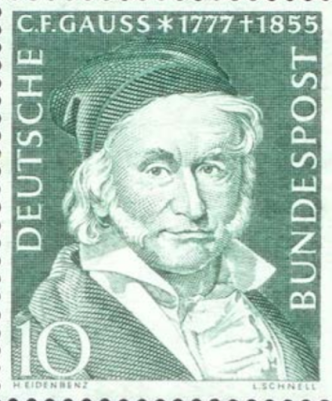
Carl Friedrich Gauss (1777-1855) – Mathematician and physicist
During his lifetime, the Braunschweig (Brunswick) native Carl Friedrich Gauss was called princeps mathematicorum, the prince of mathematics. Gauss is generally regarded as one of the greatest mathematicians of all time for his contributions to number theory, geometry, probability theory, geodesy, planetary astronomy, the theory of functions, and potential theory.
Gauss was born on April 30, 1777, in Brunswick (Braunschweig), which was then a residential town. He was the son of Gebhard Dietrich Gauss, a bricklayer, and Dorothea Emerenzia Gauss.
At the age of 14, Gauss came to the attention of the Duke of Brunswick: the Duchess saw Gauss reading in the palace yard one day, and was much impressed that Gauss understood what he was reading. When Gauss entered the Collegium Carolinum in 1792, the Duke of Brunswick, Carl Wilhelm Ferdinand (1735-1806), paid his tuition.
Gauss learnt mathematics primarily on his own. He was an autodidact. His library allows to follow the traces of his learning. He began with easy books, like the reckoning masters. For example, Gauss’ library contains books of Johann Hemeling and Valentin Heins. Mathematical textbooks came after.
At the Collegium, Gauss studied the works of Newton, Euler, and Lagrange. His investigations on the distribution of primes in 1792 or 1793 give an early indication of his interest in number theory. He also developed his strong love of languages: he “completed his knowledge of the ancient languages and learned the modern languages”.
Gauss attended the University of Göttingen and in 1799 obtained a Doctorate in Mathematics from the University of Helmstedt. About this time, he turned his attention to astronomy, making brilliant computations of orbits of asteroids.
His dissertation, written in Latin, of 1799 is dedicated with enormous gratitude to his sovereign “Serenissimo Principi Ac Domino Carolo Guilielmo Ferdinando”. His dissertation adviser was the most respected German mathematician of the time, Johann Friedrich Praff (1765-1825).
In 1801 he published at last his Disquisitiones arithmeticae, his arithmetical masterpiece concerning number theory. His sources had mostly been French mathematicians and Euler. The book is divided into seven chapters, called sections. The first three are introductory, sections IV–VI form the central part of the work and section VII is a short monograph devoted to a separate but related subject.
Gauss’ astronomical main work Theoria motus corporum coelestium in sectionibus conicis solem ambientium (Theory of the motion of the heavenly bodies moving about the sun in conic sections) appeared in Hamburg in the early summer of 1809.
In 1807, Gauss became director of the observatory in Göttingen, a post he held until his death in 1855.
Carl Friedrich Gauss (1777-1855) – Mathematician and physicist
Gauss was born on April 30, 1777, in Brunswick (Braunschweig), which was then a residential town. He was the son of Gebhard Dietrich Gauss, a bricklayer, and Dorothea Emerenzia Gauss.
At the age of 14, Gauss came to the attention of the Duke of Brunswick: the Duchess saw Gauss reading in the palace yard one day, and was much impressed that Gauss understood what he was reading. When Gauss entered the Collegium Carolinum in 1792, the Duke of Brunswick, Carl Wilhelm Ferdinand (1735-1806), paid his tuition.
Gauss learnt mathematics primarily on his own. He was an autodidact. His library allows to follow the traces of his learning. He began with easy books, like the reckoning masters. For example, Gauss’ library contains books of Johann Hemeling and Valentin Heins. Mathematical textbooks came after.
At the Collegium, Gauss studied the works of Newton, Euler, and Lagrange. His investigations on the distribution of primes in 1792 or 1793 give an early indication of his interest in number theory. He also developed his strong love of languages: he “completed his knowledge of the ancient languages and learned the modern languages”.
Gauss attended the University of Göttingen and in 1799 obtained a Doctorate in Mathematics from the University of Helmstedt. About this time, he turned his attention to astronomy, making brilliant computations of orbits of asteroids.
His dissertation, written in Latin, of 1799 is dedicated with enormous gratitude to his sovereign “Serenissimo Principi Ac Domino Carolo Guilielmo Ferdinando”. His dissertation adviser was the most respected German mathematician of the time, Johann Friedrich Praff (1765-1825).
In 1801 he published at last his Disquisitiones arithmeticae, his arithmetical masterpiece concerning number theory. His sources had mostly been French mathematicians and Euler. The book is divided into seven chapters, called sections. The first three are introductory, sections IV–VI form the central part of the work and section VII is a short monograph devoted to a separate but related subject.
Gauss’ astronomical main work Theoria motus corporum coelestium in sectionibus conicis solem ambientium (Theory of the motion of the heavenly bodies moving about the sun in conic sections) appeared in Hamburg in the early summer of 1809.
In 1807, Gauss became director of the observatory in Göttingen, a post he held until his death in 1855.
Carl Friedrich Gauss (1777-1855) – Mathematician and physicist
Labels:
Carl Friedrich Gauss,
mathematician,
physicist
Saturday, December 11, 2021
Hans Albrecht Bethe: German-American nuclear physicist
Hans Albrecht Bethe (July 2, 1906 – March 6, 2005) was a German and American nuclear physicist. Born in Strasbourg, Hans Bethe demonstrated an early genius in math.
He studied physics at the University of Frankfurt in 1924. He discovered that he had little facility for experimental physics, but Bethe’s interest in mathematics drove him to take up theoretical physics.
In 1926, he left Frankfurt to study under Arnold Sommerfeld, professor of theoretical physics at the University of Munich.
He received PhD in 1928 from the University of Munch and he did post-doctoral work at Cambridge and at Enrico Fermi’s laboratory in Rome.
He emigrated to England in 1933 and in 1935, Bethe moved to the United States, where he joined the Cornell University faculty. For most of his career, Bethe was a professor at Cornell University.
In 1943, spurred by fears that Nazi Germany was building a nuclear weapon, he accepted J. Robert Oppenheimer’s request to move to Los Alamos and head the theoretical division.
Bethe was Nobel laureate in Physics for his work on the theory of stellar nucleo-synthesis. His identification of two thermonuclear reaction chains as the power source of main-sequence stars was a decisive turning point in research on stellar structure and evolution.
Bethe’s work in theoretical nuclear physics explained how stars converted mass to energy and broadened the scientific understanding of subatomic events.
Hans Albrecht Bethe: German-American nuclear physicist
He studied physics at the University of Frankfurt in 1924. He discovered that he had little facility for experimental physics, but Bethe’s interest in mathematics drove him to take up theoretical physics.
In 1926, he left Frankfurt to study under Arnold Sommerfeld, professor of theoretical physics at the University of Munich.
He received PhD in 1928 from the University of Munch and he did post-doctoral work at Cambridge and at Enrico Fermi’s laboratory in Rome.
He emigrated to England in 1933 and in 1935, Bethe moved to the United States, where he joined the Cornell University faculty. For most of his career, Bethe was a professor at Cornell University.
In 1943, spurred by fears that Nazi Germany was building a nuclear weapon, he accepted J. Robert Oppenheimer’s request to move to Los Alamos and head the theoretical division.
Bethe was Nobel laureate in Physics for his work on the theory of stellar nucleo-synthesis. His identification of two thermonuclear reaction chains as the power source of main-sequence stars was a decisive turning point in research on stellar structure and evolution.
Bethe’s work in theoretical nuclear physics explained how stars converted mass to energy and broadened the scientific understanding of subatomic events.
Hans Albrecht Bethe: German-American nuclear physicist
Labels:
Cornell University,
Hans Bethe,
Nobel Prize,
physicist,
United States
Wednesday, October 6, 2021
Isaac Newton: English physicist and mathematician
Born: December 25, 1642
Died: March 20, 1727
Isaac Newton was born prematurely in the manor house of the tiny village of Woolsthorpe, near Grantham in Lincolnshire, England, of Hannah Ayscough and Isaac. His father, who had died 3 months before Newton was born, was a yeoman farmer, who if not wealthy had sufficient means, and left a sizeable will. When Newton was 3 years old, his mother remarried the rector Barnabas Smith, from the next village 2 km away, leaving Newton to be raised by his grandparents.
He attended the King’s School in Grantham where he learned Latin among other things until the age of 17. In 1661, he was admitted to Trinity College, Cambridge. He went to Cambridge University, intent on obtaining a law degree. Instruction at Cambridge was dominated by the philosophy of Aristotle but Newton also studied the philosophy of Descartes, Gassendi, Hobbes, and in particular Boyle. While at Cambridge he also became interested in mathematics, optics, physics and astronomy.
Sometime in late 1663 Newton also discovered mathematics- a subject not taught in any way at school, and barely at university. By 1664 he was buying various advanced books, which by Christmas 1664 included the works of Franz van Schootens, Descartes, and Wallis, on geometry, algebra, and infinite series. During this time period Newton seems to have absorbed much of the mathematics of his day, purely by solitary study, and become extremely interested in both pure mathematics and how it might be applied to the world.
Isaac Newton was an English physicist and mathematician, who made seminal contributions to several domains of science, and was considered a leading scientist of his era and one of the most influential scientists of all time.
Newton’s greatest achievement was his work in physics and celestial mechanics, which culminated in the theory of universal gravitation. By 1666, Newton had early versions of his three laws of motion. Using his discoveries in optics, Newton constructed the first reflecting telescope.
His invention of the reflecting telescope brought fellowship in the Royal Society in 1671. A year later he published a letter in the Transactions of the Royal Society on his “new theory of light and colours.”
In 1667 he returned to Cambridge and became a fellow of the College of the Holy and Undivided Trinity. In 1669, and at the age of 26, Newton became the Lucasian professor of mathematics.
In 1704 Newton published his Opticks (in English), & the Latin translation in 1706. It was wildly popular.
In addition to his work on optics, Newton made seminal contributions to several other scientific disciplines. In his book the Principia or “Mathematical Principles of Natural Philosophy,” which was published in 1687, Newton formulated the laws of motion and universal gravitation and is considered to have laid the foundations for classical mechanics.
He also introduced the notion of a Newtonian fluid, studied the speed of sound, and developed an empirical law of cooling among other major contributions made to scientific discovery.
In 1705 he was knighted, the first scientist to be so honoured for his work.
Isaac Newton: English physicist and mathematician
Labels:
Isaac Newton,
mathematician,
physicist
Monday, May 24, 2021
James Prescott Joule
James Prescott Joule was born on Christmas Eve 1818 into a wealthy brewing family. He was born in Salford near Manchester, the heartland of the industrial Revolution.
A sickly child, he was tutored at home. He showed an early interest in science and appears to have derived particular amusement from passing electric shocks through servants and friends and from some hazardous attempts to capture atmospheric electricity with a kite.
At the age of 16 he was sent to the Manchester Literary and Philosophy Society (Lit & Phil) to be taught chemistry, physics, mathematics by the eminent Manchester scientist, John Dalton (1766- 1844); a local teacher and natural philosopher with radical scientific ideas.
Joule managed the family brewery from 1837 to 1856 which enabled him to experiment on the relationships between heat and electricity in a laboratory built in the cellar of his father’s home.
Joule’s experiment had a big influence and was one of the most relevant results around the emergence of the principle of conservation of energy. His ingenious experiment and extraordinary precision (considering the technical possibilities of the time) changed (or confirmed) the way scientists understood heat, and contributed to the birth of modern thermodynamics.
Throughout most of his life Joule was an isolated amateur scientist, but toward the end of his years his work was recognized by honorary doctorates from Dublin and Oxford. In his honor the unit of energy was named the joule.
Sickness dogged his final years and he died on 11 October 1889 in his house at 12, Wardle Road, Sale, Manchester.
James Prescott Joule
A sickly child, he was tutored at home. He showed an early interest in science and appears to have derived particular amusement from passing electric shocks through servants and friends and from some hazardous attempts to capture atmospheric electricity with a kite.
At the age of 16 he was sent to the Manchester Literary and Philosophy Society (Lit & Phil) to be taught chemistry, physics, mathematics by the eminent Manchester scientist, John Dalton (1766- 1844); a local teacher and natural philosopher with radical scientific ideas.
Joule managed the family brewery from 1837 to 1856 which enabled him to experiment on the relationships between heat and electricity in a laboratory built in the cellar of his father’s home.
Joule’s experiment had a big influence and was one of the most relevant results around the emergence of the principle of conservation of energy. His ingenious experiment and extraordinary precision (considering the technical possibilities of the time) changed (or confirmed) the way scientists understood heat, and contributed to the birth of modern thermodynamics.
Throughout most of his life Joule was an isolated amateur scientist, but toward the end of his years his work was recognized by honorary doctorates from Dublin and Oxford. In his honor the unit of energy was named the joule.
Sickness dogged his final years and he died on 11 October 1889 in his house at 12, Wardle Road, Sale, Manchester.
James Prescott Joule
Labels:
James Prescott Joule,
physicist,
United Kingdom
Friday, February 26, 2021
John Dalton: English scientist
John Dalton is best known for his atomic theory and research in color blindness. John Dalton was born on 6 September 1766 at the village of Eaglesfield near Cockermouth in Cumberland, a stronghold of the Society of Friends.
Both his parents came of Quaker stock from which Dalton inherited his love of learning. Quaker schoolmaster in the village school taught him mathematics with a practical bent.
At the early age of twelve, Dalton started to teach mathematics, under the influence of his teacher Elihu Robinson—a Quaker interested in natural philosophy and meteorology. His village school was in an old barn and later in the Quakers’ Meeting House.
Dalton never had a formal education in chemistry, but it was probably at this point that he had his first contact with popular books on Newtonianism from which he began to build his scientific ideas. In 1780, Dalton moved to Kendal, where he became a teacher in a Quaker school.
At Kendal Dalton was lucky in meeting a remarkably able blind man, John Gough, who taught him languages and mathematics and encouraged him to start a meteorological journal in 1787, which Dalton continued until the day before his death.
He worked on color-blindness and meteorology. Dalton realized that he and his brother were both unable to see red. He had discovered this, apparently, when sent by his mother to buy some thread matching her grey Quaker dress; he returned with scarlet, which looked the same to him.
His initiative in making his own barometer, thermometer, rain gauge and hygrometer, shows Dalton’s innate experimental ingenuity. With these instruments Dalton made daily observations for five years, 1788 to 1792, of the barometric pressure and the wind, of the temperature of the air, of its hygrometric state and rainfall, and also of the occurrence of snow and ice, of thunder, and in great detail of the aurora borealis.
He is chiefly remembered for his atomic theory. Dalton proposed the Atomic Theory in 1803. The theory held that all matter was composed of small particles, elements possess unique characteristics and weight, and that there are three types of atoms simple, compound, and complex. He was the first to suggest the mass of one atom of hydrogen as the atomic mass unit. The unit became the dalton.
He was elected into the Royal Society in 1822 and was awarded the first Royal Medal in 1826. On 27 July, in Manchester, Dalton fell from his bed and was found lifeless by his attendant.
John Dalton: English scientist
Both his parents came of Quaker stock from which Dalton inherited his love of learning. Quaker schoolmaster in the village school taught him mathematics with a practical bent.
At the early age of twelve, Dalton started to teach mathematics, under the influence of his teacher Elihu Robinson—a Quaker interested in natural philosophy and meteorology. His village school was in an old barn and later in the Quakers’ Meeting House.
Dalton never had a formal education in chemistry, but it was probably at this point that he had his first contact with popular books on Newtonianism from which he began to build his scientific ideas. In 1780, Dalton moved to Kendal, where he became a teacher in a Quaker school.
At Kendal Dalton was lucky in meeting a remarkably able blind man, John Gough, who taught him languages and mathematics and encouraged him to start a meteorological journal in 1787, which Dalton continued until the day before his death.
He worked on color-blindness and meteorology. Dalton realized that he and his brother were both unable to see red. He had discovered this, apparently, when sent by his mother to buy some thread matching her grey Quaker dress; he returned with scarlet, which looked the same to him.
His initiative in making his own barometer, thermometer, rain gauge and hygrometer, shows Dalton’s innate experimental ingenuity. With these instruments Dalton made daily observations for five years, 1788 to 1792, of the barometric pressure and the wind, of the temperature of the air, of its hygrometric state and rainfall, and also of the occurrence of snow and ice, of thunder, and in great detail of the aurora borealis.
He is chiefly remembered for his atomic theory. Dalton proposed the Atomic Theory in 1803. The theory held that all matter was composed of small particles, elements possess unique characteristics and weight, and that there are three types of atoms simple, compound, and complex. He was the first to suggest the mass of one atom of hydrogen as the atomic mass unit. The unit became the dalton.
He was elected into the Royal Society in 1822 and was awarded the first Royal Medal in 1826. On 27 July, in Manchester, Dalton fell from his bed and was found lifeless by his attendant.
John Dalton: English scientist
Labels:
atomic theory,
chemist,
John Dalton,
physicist
Wednesday, November 25, 2020
Ernest Rutherford: Father of nuclear physics
Ernest Rutherford was born on 30th August 1871 at a small town called Bridgewater near Nelson, New Zealand.
His father, James was a Scottish wheelwright and engineer who had emigrated from Perth, Scotland, and his mother, Martha Thomson, was an English school teacher from Essex, England. Ernest Rutherford grew up in a large family; he was the fourth child in a family with 12 children.
In 1893 Ernest graduated with an M.A. with double first-class honors, first in Mathematics and Mathematical Physics then in Physical Sciences from the University of New Zealand in Wellington and gained a B.Sc.
He researched magnetism and radio wave detection for 2 years before he was awarded a prestigious “1851 Exhibition Scholarship” to work as a research student at the Cavendish Laboratory, Cambridge, under J.J. Thomson. While working under J. J. Thomson, Rutherford began a lot of work in radioactivity, using X-rays from radioactive atoms discovered in 1896. In 1898, Rutherford discovered alpha and beta rays in uranium radiation.
In 1898 at the age of 26 he took up a chair at McGill University, Montreal, where he worked till 1907. During 9 years at McGill University in Canada he explained radioactivity as the natural transmutation of atoms, discovered radon, and dated the age of the Earth.
He moved back to the UK, to accept the Langworthy Professorship at Manchester University, where he carried out his most famous work, where he discovered the nuclear structure of atoms, and became the first person to split an atom.
In 1904 Rutherford published his first book Radioactivity and in 1908 received the Nobel Prize in Chemistry ‘for his investigations into the disintegration of the elements and the chemistry of radioactive substances’.
Rutherford published his model of the atom in 1911 as an interpretation of the α-scattering work carried out by Geiger and Marsden two years earlier. He was knighted in New Year Honors of 1914.
After his death on 19 October 1937, he was buried in Westminster Abbey near Sir Isaac Newton.
Ernest Rutherford: Father of nuclear physics
His father, James was a Scottish wheelwright and engineer who had emigrated from Perth, Scotland, and his mother, Martha Thomson, was an English school teacher from Essex, England. Ernest Rutherford grew up in a large family; he was the fourth child in a family with 12 children.
In 1893 Ernest graduated with an M.A. with double first-class honors, first in Mathematics and Mathematical Physics then in Physical Sciences from the University of New Zealand in Wellington and gained a B.Sc.
He researched magnetism and radio wave detection for 2 years before he was awarded a prestigious “1851 Exhibition Scholarship” to work as a research student at the Cavendish Laboratory, Cambridge, under J.J. Thomson. While working under J. J. Thomson, Rutherford began a lot of work in radioactivity, using X-rays from radioactive atoms discovered in 1896. In 1898, Rutherford discovered alpha and beta rays in uranium radiation.
In 1898 at the age of 26 he took up a chair at McGill University, Montreal, where he worked till 1907. During 9 years at McGill University in Canada he explained radioactivity as the natural transmutation of atoms, discovered radon, and dated the age of the Earth.
He moved back to the UK, to accept the Langworthy Professorship at Manchester University, where he carried out his most famous work, where he discovered the nuclear structure of atoms, and became the first person to split an atom.
In 1904 Rutherford published his first book Radioactivity and in 1908 received the Nobel Prize in Chemistry ‘for his investigations into the disintegration of the elements and the chemistry of radioactive substances’.
Rutherford published his model of the atom in 1911 as an interpretation of the α-scattering work carried out by Geiger and Marsden two years earlier. He was knighted in New Year Honors of 1914.
After his death on 19 October 1937, he was buried in Westminster Abbey near Sir Isaac Newton.
Ernest Rutherford: Father of nuclear physics
Labels:
Ernest Rutherford,
nuclear physics,
physicist,
United Kingdom
Wednesday, October 21, 2020
Anglo-Irish physicist: Ernest Walton
Ernest Thomas Sinton Walton (6 October 1903 – 25 June 1995) was born in Dungarvan, Co. Waterford, in 1903, son of Methodist Minister from Tipperary, John Walton and Anne E. Sinton.
In his early years Ernest Walton attended schools in Banbridge and Cookstown before his seven years as a boarder in Methodist College, Belfast, from 1915 to 1922, where he excelled in science and mathematics.
Walton entered Trinity College Dublin in 1922 on scholarship and took a first-class honors degree in Physics and Mathematics (1926).
Upon graduation in 1926, Walton decided to pursue a Master’s degree by research in hydrodynamics for which he was awarded the McCullagh prize in mathematics.
He received a research scholarship to work with Ernest Rutherford (1871-1937) at
the Cavendish Laboratory, Cambridge. Walton’s first job in Cavendish Laboratory was to build an apparatus capable of accelerating electrons to very high speeds.
In 1929 Walton was joined by J.D. Cockroft. They succeeded in constructing just such a device in 1932. The new accelerator was a significant development in 20th-centiry physics as it provided a tool for study of the nucleus and its particles, but it was Walton’s first use of the new machine that was to bring the brilliant young Irish research to the fore.
The ‘atom-splitting’ experiment grabbed the public imagination and the significance of the work was immediately appreciated by the scientific community. The Walton-Cockroft particle accelerator sparked off a huge amount of scientific research.
In 1951, Walton and John Cockcroft were recipients of Nobel Prize in Physics “for their pioneer work on the transmutation of atomic nuclei by artificially accelerated atomic particles."
Anglo-Irish physicist: Ernest Walton
In his early years Ernest Walton attended schools in Banbridge and Cookstown before his seven years as a boarder in Methodist College, Belfast, from 1915 to 1922, where he excelled in science and mathematics.
Walton entered Trinity College Dublin in 1922 on scholarship and took a first-class honors degree in Physics and Mathematics (1926).
Upon graduation in 1926, Walton decided to pursue a Master’s degree by research in hydrodynamics for which he was awarded the McCullagh prize in mathematics.
He received a research scholarship to work with Ernest Rutherford (1871-1937) at
the Cavendish Laboratory, Cambridge. Walton’s first job in Cavendish Laboratory was to build an apparatus capable of accelerating electrons to very high speeds.
In 1929 Walton was joined by J.D. Cockroft. They succeeded in constructing just such a device in 1932. The new accelerator was a significant development in 20th-centiry physics as it provided a tool for study of the nucleus and its particles, but it was Walton’s first use of the new machine that was to bring the brilliant young Irish research to the fore.
The ‘atom-splitting’ experiment grabbed the public imagination and the significance of the work was immediately appreciated by the scientific community. The Walton-Cockroft particle accelerator sparked off a huge amount of scientific research.
In 1951, Walton and John Cockcroft were recipients of Nobel Prize in Physics “for their pioneer work on the transmutation of atomic nuclei by artificially accelerated atomic particles."
Anglo-Irish physicist: Ernest Walton
Labels:
Ernest Walton,
Nobel Prize,
physicist
Monday, August 10, 2020
James Clerk Maxwell: Scottish scientist
James Clerk Maxwell (13 June 1831 – 5 November 1879) was a physicists’ physicist, the prime author of the modern theory of colour vision, the principal creator of statistical thermodynamics, and above all the author of the classical electromagnetic theory, with its identification of light and electromagnetic waves.
James Clerk Maxwell was born at 14 India Street, Edinburgh, but he spent his early childhood (1831-41) at Glenlair in Scotland. His mother tragically died from cancer when he was eight-and-a-half years old. His father John Clerk Maxwell was an inspirational man—a lawyer with a strong scientific and technical interest: idiosyncratic, enquiring, versatile, energetic, compassionate, an independent character who educated young James by example more diversely than any formal school could have achieved.
His father did not neglect James’s formal education. He attended the school at Edinburgh Academy during 1841-47. While in school, at the age of 14, he published his first scientific paper ‘On the description of oval curves and those having a plurality of foci’. This fascination for geometry and for mechanical models continued through his whole career, and was of great help in his subsequent research.
From 1847 to 1850 he attended Edinburgh University when he was sixteen, and during this time he worked on the application of optical techniques to the study of elastic solids; from 1850 to 1854 to the University of Cambridge as an undergraduate, initially to Peterhouse but before the first year was out to Trinity.
In 1854 he came overall second in the final examinations, beaten only by E.J. Routh (of Routh's Rule for calculating moments of inertia). He was immediately given a staff position at Cambridge. Released from the pressures of formal examinations. Maxwell threw himself into original work.
In early 1856, James Clerk Maxwell, a young Fellow of Trinity, applied for the post of professor of natural philosophy at Marischal College, Aberdeen.
He soon found a post at King's College, London, where he came into contact with Faraday. At London, he published many of his most famous papers, including his Dynamical Theory of the Electromagnetic Field in 1864 which included the famous equations.
In 1865 Maxwell published A Dynamical Theory of the Electromagnetic Field. It was with this that he first proposed that light was in fact undulations in the same medium that is the cause of electric and magnetic phenomena. His work in producing a unified model of electromagnetism is one of the greatest advances in physics.
James Clerk Maxwell: Scottish scientist
James Clerk Maxwell was born at 14 India Street, Edinburgh, but he spent his early childhood (1831-41) at Glenlair in Scotland. His mother tragically died from cancer when he was eight-and-a-half years old. His father John Clerk Maxwell was an inspirational man—a lawyer with a strong scientific and technical interest: idiosyncratic, enquiring, versatile, energetic, compassionate, an independent character who educated young James by example more diversely than any formal school could have achieved.
His father did not neglect James’s formal education. He attended the school at Edinburgh Academy during 1841-47. While in school, at the age of 14, he published his first scientific paper ‘On the description of oval curves and those having a plurality of foci’. This fascination for geometry and for mechanical models continued through his whole career, and was of great help in his subsequent research.
From 1847 to 1850 he attended Edinburgh University when he was sixteen, and during this time he worked on the application of optical techniques to the study of elastic solids; from 1850 to 1854 to the University of Cambridge as an undergraduate, initially to Peterhouse but before the first year was out to Trinity.
In 1854 he came overall second in the final examinations, beaten only by E.J. Routh (of Routh's Rule for calculating moments of inertia). He was immediately given a staff position at Cambridge. Released from the pressures of formal examinations. Maxwell threw himself into original work.
In early 1856, James Clerk Maxwell, a young Fellow of Trinity, applied for the post of professor of natural philosophy at Marischal College, Aberdeen.
He soon found a post at King's College, London, where he came into contact with Faraday. At London, he published many of his most famous papers, including his Dynamical Theory of the Electromagnetic Field in 1864 which included the famous equations.
In 1865 Maxwell published A Dynamical Theory of the Electromagnetic Field. It was with this that he first proposed that light was in fact undulations in the same medium that is the cause of electric and magnetic phenomena. His work in producing a unified model of electromagnetism is one of the greatest advances in physics.
James Clerk Maxwell: Scottish scientist
Labels:
James Clerk Maxwell,
mathematician,
physicist,
Scottish
Sunday, July 26, 2020
Hans Christian Oersted: Danish physicist
Hans Christian Oersted (14 August 1777 – 9 March 1851) a distinguished Danish physicist and chemist was born in the town of Rudkobing, on the Danish island of Langeland, where his parents, Søren Christian and Karen (n´ee Hermansdatter), owned the local pharmacy. Because of family problems, Hans and his younger brother were placed with a German wigmaker while they were still young boys.
In 1794 the brothers, with no prior formal education, were accepted by the University of Copenhagen, where Hans studied astronomy, chemistry, mathematics, physics, and pharmacy. He completed his training in pharmacy in 1797. At age 22, in 1799, he graduated with a Ph.D. Between 1800 and 1820, he was a university teacher, researcher, publisher, and one of the most sought-after lecturers of his day.
Alessandro Volta discovered the galvanic battery in 1800, and this inspired Ørsted to ponder the nature of electricity and conduct his first electrical research experiments. Electromagnetism was discovered in the spring of 1820 by Oersted during a lecture to an advanced group of students, he demonstrated that electric current in a wire can deflect a magnetized compass needle, a phenomenon the importance of which was rapidly recognized and which inspired the development of electromagnetic theory.
By July of that year, he was certain that an electric current produced about it a circular magnetic field, and he published his results in a short paper, written in Latin, and carried by the major scientific journals of Europe.
Although he made no attempt to explain electromagnetic presence through mathematical formulas, Ørsted was credited with its discovery. Following this historic breakthrough, the pioneering field of electromagnetic study rapidly evolved, accompanied by a surge of new theories and fresh technological applications.
The Danish government funded Oersted to further his education in other European countries – he spent the years 1801 to 1803 in Germany and France.
Oersted's great discovery had an enormous impact on the scientific world. More than a hundred scientists published their comments and researches on electromagnetism within seven years of the discovery, and Oersted was showered with honors and awards. The Royal Society of London gave him the Copley Medal, and the French Academy awarded him a prize of 3000 gold francs.
Hans Christian Oersted: Danish physicist
In 1794 the brothers, with no prior formal education, were accepted by the University of Copenhagen, where Hans studied astronomy, chemistry, mathematics, physics, and pharmacy. He completed his training in pharmacy in 1797. At age 22, in 1799, he graduated with a Ph.D. Between 1800 and 1820, he was a university teacher, researcher, publisher, and one of the most sought-after lecturers of his day.
Alessandro Volta discovered the galvanic battery in 1800, and this inspired Ørsted to ponder the nature of electricity and conduct his first electrical research experiments. Electromagnetism was discovered in the spring of 1820 by Oersted during a lecture to an advanced group of students, he demonstrated that electric current in a wire can deflect a magnetized compass needle, a phenomenon the importance of which was rapidly recognized and which inspired the development of electromagnetic theory.
By July of that year, he was certain that an electric current produced about it a circular magnetic field, and he published his results in a short paper, written in Latin, and carried by the major scientific journals of Europe.
Although he made no attempt to explain electromagnetic presence through mathematical formulas, Ørsted was credited with its discovery. Following this historic breakthrough, the pioneering field of electromagnetic study rapidly evolved, accompanied by a surge of new theories and fresh technological applications.
The Danish government funded Oersted to further his education in other European countries – he spent the years 1801 to 1803 in Germany and France.
Oersted's great discovery had an enormous impact on the scientific world. More than a hundred scientists published their comments and researches on electromagnetism within seven years of the discovery, and Oersted was showered with honors and awards. The Royal Society of London gave him the Copley Medal, and the French Academy awarded him a prize of 3000 gold francs.
Hans Christian Oersted: Danish physicist
Labels:
Danish,
Hans Christian Oersted,
physicist
Monday, July 6, 2020
Christiaan Huygens: the founder of modern mathematical physics
Christiaan Huygens Dutch mathematician, astronomer, and physicist, who founded the wave theory of light, discovered the true shape of the rings of Saturn, and made original contributions to the science of dynamics—the study of the action of forces on bodies.
Christiaan Huygens was born on 14 April 1629 in den Haag (the Hague), the second child of the poet and statesman Constantijn Huygens and his wife, Suzanna van Baerle. Christiaan’s father was one of the best-known poets and authors of the Netherlands, and Christiaan was taught at home by his father and private tutors.
From May 1645 until March 1647 Christiaan studies law and mathematics at the University of Leiden, the oldest university in the Netherlands. He studied classical mathematics as well as the modern methods of Viéte, Descartes, and Fermat.
Christiaan took courses from Franz van Schootens, the best-known mathematician in the Netherlands at that time, and a friend of (and prominent exponent of the ideas of) Descartes.
In 1651, Huygens was to discover a well-concealed flaw in the vast work of Gregorius van Saint-Vincent on the quadrature of the circle [the surface area under the segment of a circle], meriting this praise from Van Schooten for his work.
Huygens at first concentrated on mathematics: determinations of quadratures and cubatures, and algebraic problems inspired by Pappus’ works. In 1651 the Theoremata de quadratura hyperboles, ellipsis et circuli appeared, Huygens was to discover a well-concealed flaw in the vast work of Gregorius van Saint-Vincent on the quadrature of the circle [the surface area under the segment of a circle], meriting this praise from Van Schooten for his work.
In 1656 Huygens invented the pendulum clock. In 1664 Thévenot approached Huygens to offer him membership in an academy to be founded in Paris; Colbert proposed giving official status and financial aid to those informal meetings of scholars which had been held in Paris since Mersenne’s time. In 1666 Huygens became one of the founding members of the French Academy of Sciences, which granted him a pension larger than that of any other member and an apartment in its building.
Huygens wrote his greatest works - the Horologium Oscillatorium and the Treatise on Light – retired from the public eye in his home in Holland due to ill health.
In 1694 Huygens fell ill. He did not recover. He died the following summer in The Hague on 8 July 1695.
Christiaan Huygens: the founder of modern mathematical physics
Christiaan Huygens was born on 14 April 1629 in den Haag (the Hague), the second child of the poet and statesman Constantijn Huygens and his wife, Suzanna van Baerle. Christiaan’s father was one of the best-known poets and authors of the Netherlands, and Christiaan was taught at home by his father and private tutors.
From May 1645 until March 1647 Christiaan studies law and mathematics at the University of Leiden, the oldest university in the Netherlands. He studied classical mathematics as well as the modern methods of Viéte, Descartes, and Fermat.
Christiaan took courses from Franz van Schootens, the best-known mathematician in the Netherlands at that time, and a friend of (and prominent exponent of the ideas of) Descartes.
In 1651, Huygens was to discover a well-concealed flaw in the vast work of Gregorius van Saint-Vincent on the quadrature of the circle [the surface area under the segment of a circle], meriting this praise from Van Schooten for his work.
Huygens at first concentrated on mathematics: determinations of quadratures and cubatures, and algebraic problems inspired by Pappus’ works. In 1651 the Theoremata de quadratura hyperboles, ellipsis et circuli appeared, Huygens was to discover a well-concealed flaw in the vast work of Gregorius van Saint-Vincent on the quadrature of the circle [the surface area under the segment of a circle], meriting this praise from Van Schooten for his work.
In 1656 Huygens invented the pendulum clock. In 1664 Thévenot approached Huygens to offer him membership in an academy to be founded in Paris; Colbert proposed giving official status and financial aid to those informal meetings of scholars which had been held in Paris since Mersenne’s time. In 1666 Huygens became one of the founding members of the French Academy of Sciences, which granted him a pension larger than that of any other member and an apartment in its building.
Huygens wrote his greatest works - the Horologium Oscillatorium and the Treatise on Light – retired from the public eye in his home in Holland due to ill health.
In 1694 Huygens fell ill. He did not recover. He died the following summer in The Hague on 8 July 1695.
Christiaan Huygens: the founder of modern mathematical physics
Labels:
Christiaan Huygens,
mathematician,
physicist
Sunday, November 24, 2019
Michael Faraday (22 September 1791 – 25 August 1867): British physicist and chemist
Michael Faraday was born in 1791 in the village of Newington, now part of the urban area of London. His father was a blacksmith who had migrated from the north of England earlier in 1791 to look for work and his family was able to allow him but the most basic education.
He was hired in a London bookshop, run by Mr. George Riebau. This work enabled Michael Faraday to read many books, that passed through the bookshop of Mr. Riebau. In his spare time he was an avid reader, teaching himself many scientific concepts.
With the help of a customer of the shop, in 1812 Faraday was able to attend the public lectures of one of the most famous scientists of the day, the chemist Humphry Davy, director of the Royal Society. For our Michael it was a veritable godsend, and perhaps precisely for this reason, also thanks to his curiosity and his initiative, he was able to exploit this opportunity more than anyone else.
In 1813 he was appointed as Chemical Assistant at the Royal Institution. During his stay at the Royal Institution, Faraday managed to obtain the two fundamental laws of electrolysis.
*First LAW: For a given solution, the quantity of matter that is deposited on the electrodes is proportional to the amount of charge which passes through the solution. This implies that the ions carrying the charge through the solution have a well-defined electric charge.
*Second LAW: The monovalent ions of different sub-stances carry an equal quantity of electric charge, while the bi- or tri-valent ones carry a correspondingly higher charge.
Faraday, who became one of the greatest scientists of the 19th century, began his career as a chemist. He wrote a manual of practical chemistry that reveals his mastery of the technical aspects of his art, discovered a number of new organic compounds, among them benzene, and was the first to liquefy a “permanent” gas.
His major contribution, however, was in the field of electricity and magnetism. He was the first to produce an electric current from a magnetic field, invented the first electric motor and dynamo, demonstrated the relation between electricity and chemical bonding, discovered the effect of magnetism on light, and discovered and named diamagnetism, the peculiar behaviour of certain substances in strong magnetic fields.
Faraday was the author of numerous publications in scientific journals. his main contributions are collected in his Laboratory Journal, which he hold regularly from 1820 until 1862.
History of Faraday’s scientific discoveries·
*1810-1820 First Electrochemical Experiments·
*1820-1830 Electrical conduction experiments·
*1831 Law of electromagnetic induction·
*1832-1833 Laws of electrolysis·
*1837-39 Dielectric materials·
*1845-1846 Diamagnetism and Faraday effect·
*1855 Studies on paramagnetism
In 1833 he was appointed professor of chemistry at the Royal Institution and step by step he became famous worldwide. He also distinguished himself for his oratory, communication and outreach skills.
He was hired in a London bookshop, run by Mr. George Riebau. This work enabled Michael Faraday to read many books, that passed through the bookshop of Mr. Riebau. In his spare time he was an avid reader, teaching himself many scientific concepts.
With the help of a customer of the shop, in 1812 Faraday was able to attend the public lectures of one of the most famous scientists of the day, the chemist Humphry Davy, director of the Royal Society. For our Michael it was a veritable godsend, and perhaps precisely for this reason, also thanks to his curiosity and his initiative, he was able to exploit this opportunity more than anyone else.
In 1813 he was appointed as Chemical Assistant at the Royal Institution. During his stay at the Royal Institution, Faraday managed to obtain the two fundamental laws of electrolysis.
*First LAW: For a given solution, the quantity of matter that is deposited on the electrodes is proportional to the amount of charge which passes through the solution. This implies that the ions carrying the charge through the solution have a well-defined electric charge.
*Second LAW: The monovalent ions of different sub-stances carry an equal quantity of electric charge, while the bi- or tri-valent ones carry a correspondingly higher charge.
Faraday, who became one of the greatest scientists of the 19th century, began his career as a chemist. He wrote a manual of practical chemistry that reveals his mastery of the technical aspects of his art, discovered a number of new organic compounds, among them benzene, and was the first to liquefy a “permanent” gas.
His major contribution, however, was in the field of electricity and magnetism. He was the first to produce an electric current from a magnetic field, invented the first electric motor and dynamo, demonstrated the relation between electricity and chemical bonding, discovered the effect of magnetism on light, and discovered and named diamagnetism, the peculiar behaviour of certain substances in strong magnetic fields.
Faraday was the author of numerous publications in scientific journals. his main contributions are collected in his Laboratory Journal, which he hold regularly from 1820 until 1862.
History of Faraday’s scientific discoveries·
*1810-1820 First Electrochemical Experiments·
*1820-1830 Electrical conduction experiments·
*1831 Law of electromagnetic induction·
*1832-1833 Laws of electrolysis·
*1837-39 Dielectric materials·
*1845-1846 Diamagnetism and Faraday effect·
*1855 Studies on paramagnetism
In 1833 he was appointed professor of chemistry at the Royal Institution and step by step he became famous worldwide. He also distinguished himself for his oratory, communication and outreach skills.
Michael
Faraday (22 September 1791 – 25 August 1867): British physicist and chemist
Labels:
chemist,
England,
Michael Faraday,
physicist
Thursday, October 17, 2019
Gabriel Lippmann - Nobel prize of Physics 1908 for colour photography
More than one hundred years ago Gabriel Lippmann recorded the first permanent colour photographs in France. His technique based on recorded light interference structures in an emulsion produced unique colour photographs. It is known as interferential photography or interference colour photography, as well as Lippmann photography.
Gabriel Lippmann was born of French parents at Hollerich (Luxembourg) on August 16, 1845. His parents moved to Paris and eventually he was admitted to the École Normale. Pursuing only the topics that aroused his interest, Lippmann was not an ideal student.
He failed in the examination that would have qualified him as a teacher. Nevertheless, his latent abilities were recognized and he was given the opportunity to study in Heidelberg, where the celebrated physicist, Gustav Robert Kirchhoff (1824-1887) was professor.
He became head from 1886until his death in 1921 of the famous L.R.P.S. “Laboratoire des Recherches Physiques de la Sorbonne”, in which he finalized his interference colour photography.
In 1891 Lippmann announced that he had succeeded in recording a true-colour spectrum. A little more than one year later Lippmann displayed four colour photographs of different objects. Lippmann developed the first theory of recording monochromatic and polychromatic spectra. He applied Fourier mathematics to optics, which was a new approach at that time.
Lippmann died aboard ship on July 12, 1921, while returning from a visit to Canada; but by no means did interest in the development and use of the capillary electrometer die with him.
Gabriel Lippmann - Nobel prize of Physics 1908 for colour photography
Gabriel Lippmann was born of French parents at Hollerich (Luxembourg) on August 16, 1845. His parents moved to Paris and eventually he was admitted to the École Normale. Pursuing only the topics that aroused his interest, Lippmann was not an ideal student.
He failed in the examination that would have qualified him as a teacher. Nevertheless, his latent abilities were recognized and he was given the opportunity to study in Heidelberg, where the celebrated physicist, Gustav Robert Kirchhoff (1824-1887) was professor.
He became head from 1886until his death in 1921 of the famous L.R.P.S. “Laboratoire des Recherches Physiques de la Sorbonne”, in which he finalized his interference colour photography.
In 1891 Lippmann announced that he had succeeded in recording a true-colour spectrum. A little more than one year later Lippmann displayed four colour photographs of different objects. Lippmann developed the first theory of recording monochromatic and polychromatic spectra. He applied Fourier mathematics to optics, which was a new approach at that time.
Lippmann died aboard ship on July 12, 1921, while returning from a visit to Canada; but by no means did interest in the development and use of the capillary electrometer die with him.
Gabriel Lippmann - Nobel prize of Physics 1908 for colour photography
Labels:
Gabriel Lippmann,
Nobel Prize,
physicist
Wednesday, November 22, 2017
Al-Khāzini
Abu al-Fath Abd al-Rahman Mansour al-Khāzini (1115-1130) or simply Abu Al-Fath Al-Khāzini was a Muslim of Greek origin who was brought to Merv as a slave by the Seljuk king after his victory over the Byzantine Emperor.
He was the pupil of Umar Khayyam. His master is responsible for his education in mathematics and philosophy.
Al-Khāzini was a great physicist, astronomer, mathematician, philosopher and alchemist. He is better known for his contribution to physics. He is one of the few Islamic astronomers to be known for doing original observation.
His treatise: Al-Khāzini’s Kitab mizan al-hikma written in four volumes, remained an important part of physics among the Muslim scientists. It is a treatise on the physical principles that underline the hydrostatic balance as well as the construction and use o the instrument.
As an astronomer his main work is his Al-Zij al-Sanjari, an astronomical handbook with tables, compile between ca. 1118 – ca 1131 and dedicated to the Seljuk Sultan Sanjar ibn Malikshah.
Al-Khāzini
He was the pupil of Umar Khayyam. His master is responsible for his education in mathematics and philosophy.
Al-Khāzini was a great physicist, astronomer, mathematician, philosopher and alchemist. He is better known for his contribution to physics. He is one of the few Islamic astronomers to be known for doing original observation.
His treatise: Al-Khāzini’s Kitab mizan al-hikma written in four volumes, remained an important part of physics among the Muslim scientists. It is a treatise on the physical principles that underline the hydrostatic balance as well as the construction and use o the instrument.
As an astronomer his main work is his Al-Zij al-Sanjari, an astronomical handbook with tables, compile between ca. 1118 – ca 1131 and dedicated to the Seljuk Sultan Sanjar ibn Malikshah.
Al-Khāzini
Labels:
Al-Khāzini,
astronomer,
physicist
Monday, October 5, 2015
Chu Paul Ching-Wu
Chu Paul Ching was born on December 2, 1941, in Hunan, China but his parents were members of the Nationalist Party and the family fled to Taiwan in 1949 for political reasons.
After graduating in physics from Chen Kung University, Chu moved to America in 1963. He earned his MS from Fordham University, in Bronx, New York and completed his PhD in 1968 at the University of California, San Diego.
After spending two years working for the company AT & T, Chu entered academic life, first as assistant professor of physics at Cleveland State University and since 1979 as professor of physics at the University of Houston. He has held the Temple Chair since 1987.
He has been working on superconductivity since his days with Bernd T. Matthias at UCSD in the mid 196os. His other research interests are magnetism and ferroelectricity.
Chu is considered one of the most important superconductivity scientists for his 1987 discovery of a combination of materials that could conduct electricity at temperature high enough to allow for cheap, efficient energy production.
Chu Paul Ching-Wu
After graduating in physics from Chen Kung University, Chu moved to America in 1963. He earned his MS from Fordham University, in Bronx, New York and completed his PhD in 1968 at the University of California, San Diego.
After spending two years working for the company AT & T, Chu entered academic life, first as assistant professor of physics at Cleveland State University and since 1979 as professor of physics at the University of Houston. He has held the Temple Chair since 1987.
He has been working on superconductivity since his days with Bernd T. Matthias at UCSD in the mid 196os. His other research interests are magnetism and ferroelectricity.
Chu is considered one of the most important superconductivity scientists for his 1987 discovery of a combination of materials that could conduct electricity at temperature high enough to allow for cheap, efficient energy production.
Chu Paul Ching-Wu
Labels:
American scientist,
Chinese,
Chu Paul Ching-Wu,
physicist
Wednesday, September 9, 2015
Robert Goddard: Inventor of the first liquid-fueled rocket
Robert Goddard was the brilliant, but reclusive, American physicist who promoted rocket science and cofounded the field of astronautics in the early part of the 20th century.
Robert Goddard (October 5, 1882 – August 10, 1945) was born in Worchester, Massachusetts to Nahum Danford Goddard and Fannie Louise Hoyt Goddard.
His father was a machine shop superintendent and visits to his father’s shop helped nurture his fascination with gears, levers and all types of mechanical gadgets. Goddard suffered from stomach problems as a child and as a result fell two years behind in his schoolwork.
As he matured, he became deeply interested in reading and reportedly made regular visit to his local library,
He received bachelor’s degree in physics from Worchester Polytechnic Institute in 1908, a master’s degree from Clark University in 1910, and a PhD from Clark University in 1911.In 1912, he moved to Princeton University on a research fellowship.
However, he suffered a near-fatal relapse of pulmonary tuberculosis in 1913 that incapacitated him for many months. Recovered, Goddard joined the faculty at Clark University the following year as an instructor of physics.
By 1920 he was a full professor of physics and also the director of the physical laboratories at Clark.
Inspired by writings of H. G. Wells, The War of the Worlds, Goddard began experimenting with solid propellant rockets during World War I. In 1919, he published a book titled A Method of Reaching Extreme Altitudes which is one of the reasons he is known as one of the founders of modern rocketry.
He set about experimenting with liquid engines in 1923 and launched his first successful flight on March 26, 1926.
Goddard conducted more than 100 static tests, 48 live flight tests and developed the first functional gyroscopic attitude control system for rocket.
Robert Goddard: Inventor of the first liquid-fueled rocket
Robert Goddard (October 5, 1882 – August 10, 1945) was born in Worchester, Massachusetts to Nahum Danford Goddard and Fannie Louise Hoyt Goddard.
His father was a machine shop superintendent and visits to his father’s shop helped nurture his fascination with gears, levers and all types of mechanical gadgets. Goddard suffered from stomach problems as a child and as a result fell two years behind in his schoolwork.
As he matured, he became deeply interested in reading and reportedly made regular visit to his local library,
He received bachelor’s degree in physics from Worchester Polytechnic Institute in 1908, a master’s degree from Clark University in 1910, and a PhD from Clark University in 1911.In 1912, he moved to Princeton University on a research fellowship.
However, he suffered a near-fatal relapse of pulmonary tuberculosis in 1913 that incapacitated him for many months. Recovered, Goddard joined the faculty at Clark University the following year as an instructor of physics.
By 1920 he was a full professor of physics and also the director of the physical laboratories at Clark.
Inspired by writings of H. G. Wells, The War of the Worlds, Goddard began experimenting with solid propellant rockets during World War I. In 1919, he published a book titled A Method of Reaching Extreme Altitudes which is one of the reasons he is known as one of the founders of modern rocketry.
He set about experimenting with liquid engines in 1923 and launched his first successful flight on March 26, 1926.
Goddard conducted more than 100 static tests, 48 live flight tests and developed the first functional gyroscopic attitude control system for rocket.
Robert Goddard: Inventor of the first liquid-fueled rocket
Labels:
physicist,
Robert Goddard,
rocket science,
United States
Sunday, March 22, 2015
Ernst Florens Friedrich Chladni (30 November 1756 – 3 April 1827)
Ernst Florens Friedrich Chladni was born in Witten berg, Germany. He was the only child of Ernst Marin and Johanna Sophia Chladni. His grandfather was a prominent Lutheran theologian and his father a distinguished jurist.
Although he was educated by his parents in a strict, rather isolated household, Chladni developed a yearning for travel and a strong interest in the natural history of the Earth and the heaven.
Chladni studied law at the universities of Leipzig and Wittenberg, receiving his doctorate at the later institution in 1782, the year of his father’s death. Chladni immediately abandoned law and remained at Wittenberg a few years to study mathematics and science.
One of Chladni’s best-known achievements was inventing a technique to show the various modes of vibration on a metallic surface.
In 1787 he published his Entdeckungen über die Theorie des Klanges (Discoveries in the Theory of Sound), consisting a drawing a bow over a piece of metal whose surface was lightly covered with sand. This plate was bowed until it reached resonance and the sand formed a pattern showing the nodal regions.
In late 1792 and early 1793, Chladni visited Gottingen to demonstrate his newly invented keyboard instrument, the euphonium and had the opportunity to talk for many hours with Lichtenberg.
Chladni was one of the first scientists to be believe that meteorites fell from the sky but his opinion was treated with disdain until Jean Baptiste Biot proved him to be correct in 1803.
Ernst Florens Friedrich Chladni (30 November 1756 – 3 April 1827)
Although he was educated by his parents in a strict, rather isolated household, Chladni developed a yearning for travel and a strong interest in the natural history of the Earth and the heaven.
Chladni studied law at the universities of Leipzig and Wittenberg, receiving his doctorate at the later institution in 1782, the year of his father’s death. Chladni immediately abandoned law and remained at Wittenberg a few years to study mathematics and science.
One of Chladni’s best-known achievements was inventing a technique to show the various modes of vibration on a metallic surface.
In 1787 he published his Entdeckungen über die Theorie des Klanges (Discoveries in the Theory of Sound), consisting a drawing a bow over a piece of metal whose surface was lightly covered with sand. This plate was bowed until it reached resonance and the sand formed a pattern showing the nodal regions.
In late 1792 and early 1793, Chladni visited Gottingen to demonstrate his newly invented keyboard instrument, the euphonium and had the opportunity to talk for many hours with Lichtenberg.
Chladni was one of the first scientists to be believe that meteorites fell from the sky but his opinion was treated with disdain until Jean Baptiste Biot proved him to be correct in 1803.
Ernst Florens Friedrich Chladni (30 November 1756 – 3 April 1827)
Wednesday, February 11, 2015
Richard Phillips Feynman (May 11, 1918 – February 15, 1988)
Known as the ‘Great Explainer,’ Richard Phillips Feynman was born in New York City in 1918 and grew up in Far Rockaway, Queens. As a child Feynman enjoyed tinkering and inventing such things as a burglar alarm for the house and a motor to rock his baby sister’s crib.
He attended the Massachusetts Institute of Technology as an undergraduate when he was a seventeen years old. He received his PhD from Princeton University in 1942. He later held an appointment at the University of Wisconsin-Madison as an assistant professor of physics.
Fearing that Germany would develop an atomic bomb before the United States, Feynman eventually signed on to Wilson’s isotron project to separate Uranium 235 from Uranium 238.
Feynman later was recruited by Julius Robert Oppenheimer to work on the Manhattan Project in Los Alamos., New Mexico.
Feynman was known for his work in the path integral formulation of quantum mechanics, the theory of quantum electrodynamics and the physics of the super-fluidity of super-cooled liquid helium, as well as in particle physics.
For his contributions to the devolvement of quantum electrodynamics, Feynman, jointly with Julian Schwinger and Sino-Itiro Tomonaga, received the Nobel Prize in Physics in 1965.
Feynman’s mathematical notation system for QED was accepted by the physics community over the systems developed by Schwinger and Tomonaga and his method of graphically drawing particle interaction, in what came to be dubbed Feynman diagrams.
Richard Phillips Feynman (May 11, 1918 – February 15, 1988)
He attended the Massachusetts Institute of Technology as an undergraduate when he was a seventeen years old. He received his PhD from Princeton University in 1942. He later held an appointment at the University of Wisconsin-Madison as an assistant professor of physics.
Fearing that Germany would develop an atomic bomb before the United States, Feynman eventually signed on to Wilson’s isotron project to separate Uranium 235 from Uranium 238.
Feynman later was recruited by Julius Robert Oppenheimer to work on the Manhattan Project in Los Alamos., New Mexico.
Feynman was known for his work in the path integral formulation of quantum mechanics, the theory of quantum electrodynamics and the physics of the super-fluidity of super-cooled liquid helium, as well as in particle physics.
For his contributions to the devolvement of quantum electrodynamics, Feynman, jointly with Julian Schwinger and Sino-Itiro Tomonaga, received the Nobel Prize in Physics in 1965.
Feynman’s mathematical notation system for QED was accepted by the physics community over the systems developed by Schwinger and Tomonaga and his method of graphically drawing particle interaction, in what came to be dubbed Feynman diagrams.
Richard Phillips Feynman (May 11, 1918 – February 15, 1988)
Subscribe to:
Posts (Atom)
The most popular articles
-
German agricultural chemist Franz Ritter von Soxhlet was born in Brno on January 12, 1848 of Belgian parents. Obtaining hi PhD from Universi...
-
Physicians have used herbs and other plants products to treat disease for centuries. During the 19th century, scientist began to pinpoint th...
-
Ernest Frederick Werner Alexanderson (1878 – 1975) Ernest Frederick Werner Alexanderson, Swedish-American electrical engineer and prolific r...
-
Isaac Newton, natural philosopher and mathematician, was born in 1642, during the Civil Wars between Cavalier and Roundhead. He was born on ...
-
Owen Harding Wangensteen (1898–1981) stands as one of the most influential figures in 20th-century surgery, remembered not only for his tech...